

Many growing companies hang on to residential-style internet until the cracks show—frozen video, stalled uploads, dropped VPNs—and every outage bleeds cash. A 2024 ITIC survey found that 90 percent of midsize firms lose more than $300,000 for each hour of downtime. If that sounds familiar, you deserve a business-grade connection like WOW! Business Internet—not merely faster, but engineered to stay up so you can work without interruptions.
Upgrading from “good enough” to the right business internet
You may have started with an entry-level or residential line because it was cheap and “good enough.” As the workload grows with more cloud apps, hybrid staff, and nonstop video calls, the cracks appear: choppy meetings, slow uploads, unstable VPNs, and a chorus of “the Wi-Fi is lagging.”
What changes? Residential cable still favors downloads. Typical home uploads sit around 10–35 Mbps, while fiber business plans deliver symmetrical 300 Mbps–1 Gbps speeds, according to HighSpeedOptions. Even the FCC’s new broadband baseline—100 Mbps down and 20 Mbps up—falls short of what a dozen employees can consume during a single video-heavy morning, according to Business.com. That baseline is only a starting point. Speed guidelines published by WOW! Business for small business fiber internet suggest that even very small teams may need 25 to 75 Mbps and that growing businesses with regular video, point-of-sale, and cloud use quickly move into the 150 Mbps to 1 Gbps range, depending on headcount and applications. Using those ranges as a cross-check for your own staff and workflows makes it clear how quickly a “good enough” residential line can become a bottleneck.
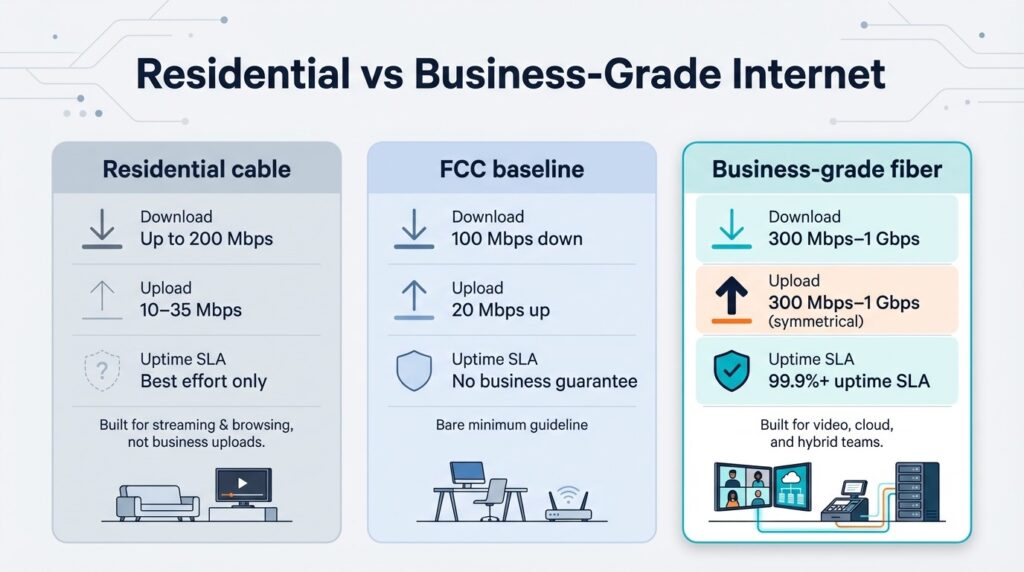

Business-grade internet delivers higher upload speeds and stronger uptime SLAs than residential “good enough” plans.
The bargain price also buys weaker service-level agreements: “best-effort” uptime for homes versus 99.9 percent (or better) guarantees for business circuits. Industry site Anytopia notes that those extra nines keep your POS terminals, phones, and remote desktops online when it counts.
If any of this sounds familiar, move past the idea of “faster” and choose WOW! Business Internet or another business-grade service built for the way you operate. Balanced uploads, dependable SLAs, and support that treats an outage like lost revenue will protect every transaction and meeting.
Recognize the signs you’ve outgrown your current connection
Trouble often starts quietly: a frozen Zoom screen, a robotic customer call, then the help-desk queue fills with “internet is down” tickets. Watch for three early warning lights:
- Video stutters or freezes. According to Zoom’s support site, 1080p HD calls need up to 3.8 Mbps of upload bandwidth; five employees on one residential line already max it out.
- Voice sounds tinny or drops. Packet loss and jitter hit audio first, so calls break up when upload headroom disappears.
- Cloud apps drag during peak hours. A 2025 TeamViewer study found U.S. workers lose an average of 1.5 days per month to IT slowdowns, including sluggish VPNs and SaaS lag.
If you see any mix of these issues, the culprit is a connection built for Netflix, not nonstop collaboration. Modern workflows back up terabytes, stream HD video, and sync files in real time; when uploads can’t keep pace, productivity slips with every buffering wheel.
Shift your thinking from price to productivity
That $95-a-month “starter” connection feels thrifty, until you count the hidden losses. Atlassian’s downtime calculator estimates $137 to $427 per minute in revenue risk for small companies when the network stalls or drops. Salesforce’s 2024 productivity survey shows owners lose 96 minutes of productive time each day to tech friction such as slow file syncs or hunting for a stable signal. Add it up and a bargain line can drain five figures every month.
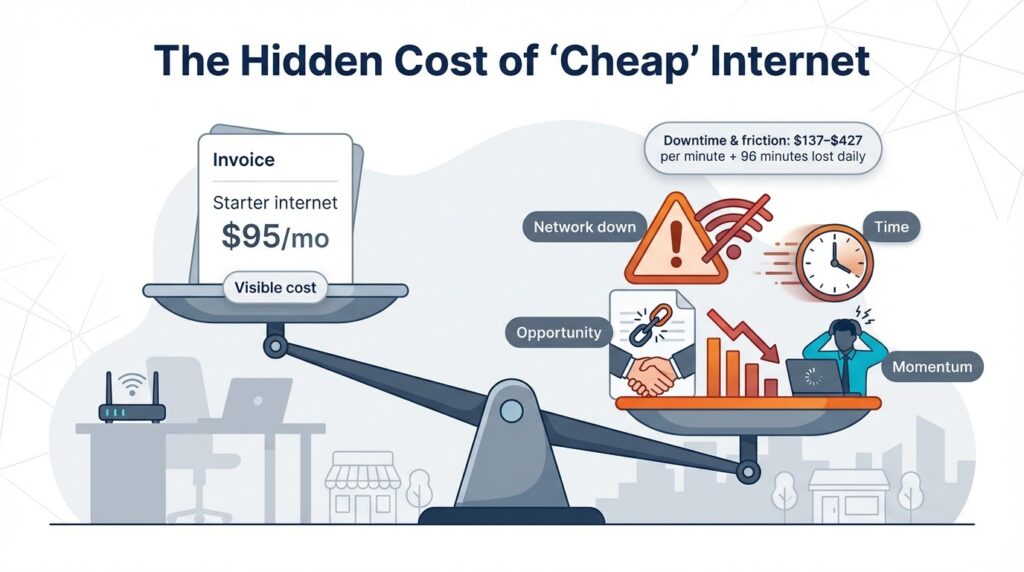
A low monthly internet bill can hide far greater costs in downtime, lost opportunities, and drained momentum.
You pay the penalty in three ways:
- Time: re-uploads, redialed calls, and stalled checkouts claim hours that never return.
- Opportunity: customers leave after a few seconds of lag, and a single glitch can derail an online demo.
- Momentum: constant interruptions sap team focus, energy, and credibility.
A business-grade circuit flips that equation. Symmetrical speeds, 99.9 percent uptime SLAs, and real-time support turn bandwidth from overhead into return on investment, often faster than any new laptop or software license.
Prioritize features that support modern workflows
Speed alone is not enough. A true business-grade circuit must match hybrid work, dense Wi-Fi, and multi-site growth. Keep three questions in view:
- Will uploads keep up? Microsoft documentation says Microsoft Teams can use about 1.5 Mbps of symmetric bandwidth per endpoint for full-HD video, so a five-person call needs roughly 7 Mbps in each direction. If your provider downplays upload capacity, meetings will fail first.
- Can Wi-Fi cover the office today and tomorrow? BenchmarkReviews notes that heavy-usage offices often need one access point for every 500 square feet or 60 to 100 devices. Seek plans that pair easily with managed mesh hardware so you can add nodes without new cable.
- Does the service scale across sites and home offices? About 35 percent of U.S. employees now work hybrid or fully remote, according to Owl Labs’ 2024 State of Hybrid Work report. A provider that can activate new locations or ship pre-configured equipment to remote staff keeps you from juggling multiple contracts later.
Choose a package that supports current headcount and the projects on your horizon, whether that means new hires, larger media files, or a second branch office. Symmetrical bandwidth and modular Wi-Fi protect productivity better than a headline download number.
Ask about installation and transition support
Switching circuits should feel like a hand-off, not major surgery. The right provider brings a clear playbook that turns days of risk into minutes of planned cutover, because every unplanned minute can cost small firms $137 to $427, according to Atlassian’s downtime calculator.
Confirm three safeguards before you sign:
- Parallel cutover: Will the technicians activate the new line and test routing while the old one still carries traffic, so the final flip takes seconds instead of hours?
- Coordination with your IT team or MSP: Shared change windows and pre-staged firewall settings keep security tight and surprises away.
- Temporary failover: Ask for LTE, 5G, or secondary broadband that switches on if something slips; a few dollars per month beats four-figure outage costs.
A well-planned transition means your first experience with the new circuit is crystal-clear video and quicker log-ins, not apology emails to clients.
Build a simple internet roadmap
Connectivity is not a one-and-done purchase; it is infrastructure that should grow as fast as your plans. Map it just as you would software rollouts or staffing projections:
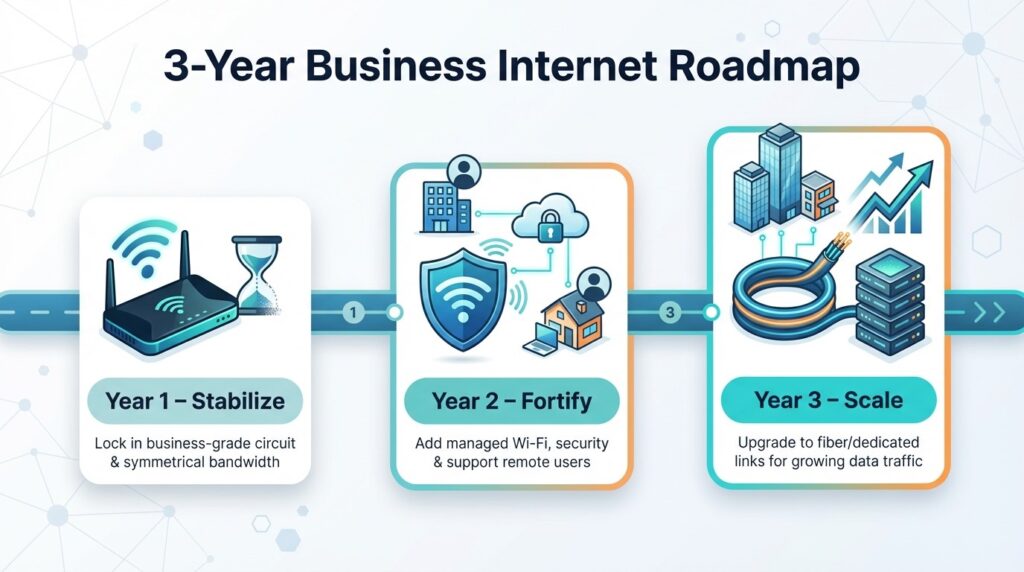
A simple three-year roadmap helps businesses stabilize today’s connectivity, fortify security and Wi‑Fi, and scale for future growth.
- Year 1 – Stabilize. Lock in a business-grade circuit such as WOW! Business Internet to remove bottlenecks and add symmetrical bandwidth.
- Year 2 – Fortify. Layer on managed Wi-Fi and security. Owl Labs reports that 22 percent of U.S. employees, about 32.6 million people, work remotely in 2025, so every access point now serves office traffic and VPN-hungry home users.
- Year 3 – Scale. Reuters reports that Cisco projects enterprise data traffic will climb 23 percent each year through 2026. As backups and video assets multiply, move high-load sites to fiber or dedicated links to secure low-latency performance.
Conclusion
Plotting these milestones today prevents last-minute scrambles when a new branch opens or a product launch spikes bandwidth. The payoff: your network expands in step with the business, turning internet service from recurring headache into lasting competitive edge.