A practical, no-fluff guide to LinkedIn outreach that actually works in SaaS — from someone who rebuilt an SDR team from scratch.
I need to tell you something that might sting a little.
That LinkedIn message your SDR sent this morning — the one that opens with “Hi [First Name], I came across your profile and was impressed by your work at [Company]” — got ignored. Not because your product is bad. Not because your SDR is lazy. But because that exact message landed in your prospect’s inbox alongside forty-seven other messages that read exactly the same way.
I know this because I’ve been on both sides of it.
At RateGain, we sell AI-powered SaaS solutions to hotels, airlines, and travel companies across 100+ countries. Our buyers are busy revenue managers, CTOs, and commercial directors who get bombarded with cold outreach all day. When I took a hard look at our SDR team’s LinkedIn numbers two years ago, the data was brutal: 4% connection acceptance rate, sub-2% reply rate, and a pipeline contribution that wasn’t justifying the headcount.
Something had to change. So we threw out the playbook and built a new one from scratch.
Twelve months later, our LinkedIn outreach reply rate sits at 18%. Our SDRs book an average of three qualified meetings per week each. And the deals that come through LinkedIn close 34% faster than deals sourced through cold email alone.
This article is that playbook. No theory. No motivational fluff. Just the exact system we use, the mistakes we made getting here, and the frameworks you can steal today.
Why Most SDR LinkedIn Outreach Fails in 2026
Let me be blunt. The average cold email reply rate in B2B SaaS has dropped to 3.4% in 2026, down from roughly 7% just two years ago. LinkedIn performs better at around 10%, but that number is misleading. It includes every spray-and-pray connection request that gets a pity acceptance but never converts.
The real problem isn’t the channel. It’s the approach.
Most SDR teams still operate on a volume-first model: send 100 connection requests a day, blast a templated pitch to everyone who accepts, follow up twice, move on. This worked in 2020. It is dead in 2026.
Here’s what killed it: LinkedIn’s algorithm now actively throttles accounts that send high volumes of identical messages. Prospects have developed pattern recognition for templated outreach — they can smell a copy-paste from the first three words. And the rise of AI SDR tools has paradoxically made the problem worse, flooding inboxes with “personalized” messages that are anything but.
The teams winning right now are doing the opposite. They send fewer messages, invest more time in research, and treat LinkedIn as a relationship platform rather than a broadcasting tool.
The Comment-First Method: Our Biggest LinkedIn Outreach Breakthrough
The single biggest shift we made at RateGain was moving from a DM-first to a comment-first outreach model for our top-tier accounts.
The idea is simple. Before you ever send someone a connection request or a direct message, you spend one to two weeks genuinely engaging with their content. Not a thumbs-up emoji. Not a “Great post!” comment. Real, thoughtful engagement that adds something to the conversation.
One of our SDRs, working the APAC hospitality vertical, started commenting on a VP of Revenue’s posts about dynamic pricing challenges. She didn’t pitch. She shared a relevant data point from a Phocuswright report in one comment. She asked a sharp follow-up question in another. By the time she sent a connection request three weeks later, the VP not only accepted — he messaged her first asking what RateGain does.
That’s the power of earning attention instead of demanding it.
How We Structure the Comment-First Cadence
We run a tiered system. Not every prospect gets the same investment of time, because not every prospect represents the same potential value.
| Tier | Account Profile | Approach | Timeline to DM |
| Tier 1 (Top 20) | Enterprise accounts, $50K+ ACV potential, named strategic targets | Comment-first. 2–3 weeks of engagement before any outreach. Research their 10-K, press releases, and LinkedIn activity. | 14–21 days |
| Tier 2 (Next 50) | Mid-market, $15–50K ACV, strong ICP fit | Hybrid. 3–5 meaningful comments, then a warm connection request referencing a specific post. | 7–10 days |
| Tier 3 (Scale) | SMB, <$15K ACV, high volume | DM-first with strong personalization. Use signals (job change, funding, tech stack) for relevance. | Direct |
The data backs this up. Comment-first outreach delivers a 2.5x higher connection acceptance rate than cold DMs. That’s not a marginal improvement. That’s a fundamentally different game.
The 5-Touch LinkedIn Prospecting Sequence That Books Meetings
After testing dozens of cadence variations, we settled on a 15-day multi-touch sequence that consistently books qualified meetings. I’m sharing the exact framework here.
Day-by-Day Breakdown
Day 1 — Profile View + Content Engagement. View their profile (they get the notification). Like and leave a substantive comment on their most recent post. If they haven’t posted recently, engage with a shared connection’s content where they’re tagged.
Day 3 — Connection Request (No Pitch). Send a connection request with a short, genuine note. Reference something specific: their post, a conference they spoke at, a company milestone. Never pitch in the connection request. Example: “Hi Sarah — your take on ancillary revenue optimization in last week’s post really resonated. We’re tackling similar challenges on the tech side. Would love to connect.”
Day 5 — Thank + Soft Value Drop. Once they accept, thank them and share something useful. Not your product brochure. A relevant article, a benchmark report, a data point that relates to what they care about. “Thanks for connecting, Sarah. Thought you’d find this interesting — Skift just published new data on ancillary revenue trends in APAC that ties into what you were writing about.”
Day 8 — The Insight Message. This is the critical message. Share a specific, relevant insight tied to their business. Not generic. Not “I noticed your company is growing.” Something that shows you’ve done research. “I noticed [their hotel group] expanded into three new markets last quarter — congrats. Curious if you’re seeing the same rate parity challenges in SEA that other groups have flagged to us. We’ve been tracking some interesting patterns.”
Day 12 — The Ask. Now, and only now, you make the ask. Keep it low friction. “Would it make sense to grab 15 minutes this week? I can share what we’re seeing across similar hotel groups — no pitch, just a comparison of notes. Either way, happy to stay connected.”
Day 15 — The Breakup + Long Game. If no response, send a no-pressure close. “Totally understand if the timing isn’t right, Sarah. I’ll keep sharing relevant stuff when I come across it. Feel free to reach out whenever it makes sense.” Then add them to your long-term nurture list and continue engaging with their content.
The “breakup” message is secretly the most powerful one. It removes pressure, and we’ve found that roughly 15% of our booked meetings come from prospects who circle back weeks or months after receiving it.
Signal-Based Prospecting: Stop Guessing, Start Timing
The second big shift we made was moving from list-based to signal-based prospecting. Instead of working through a static list of 500 accounts, our SDRs now prioritize prospects showing active buying signals.
This matters because timing is everything in outbound. A perfectly crafted message sent at the wrong time gets ignored. A decent message sent when someone is actively evaluating solutions gets a response.
The Signals We Track
- Leadership changes: A new VP of Revenue, CTO, or Commercial Director almost always means a tech stack review within six months. This is the single highest-converting signal we track.
- Funding rounds: When a company raises capital, they’re investing in growth. Growth means new tools.
- Job postings: If a hotel group is hiring revenue managers or data analysts, they’re investing in the function. They’re more receptive to solutions that make those hires more productive.
- Expansion news: New markets, new properties, acquisitions. All of these create operational complexity that our platform addresses.
- Competitor mentions: If a prospect posts about or engages with a competitor’s content, they’re in-market.
- Tech stack changes: Tools like BuiltWith and HG Insights reveal when companies adopt or drop technologies in your ecosystem.
We use LinkedIn Sales Navigator’s “Spotlight” filters combined with tools like Bombora and G2 Buyer Intent to surface these signals. But honestly, you don’t need expensive tools to start. A dedicated 20 minutes each morning scanning your prospects’ LinkedIn activity, company news, and Google Alerts gives you 80% of what the tools provide.
Writing LinkedIn Messages That Don’t Sound Like a Robot Wrote Them
This is where most SDR teams still fumble, even in 2026. They invest in targeting, signals, and cadences but then send messages that read like they were generated by an AI with zero context and maximum corporate jargon.
Here’s the framework I drill into every SDR on our team.
The 3-Line Message Formula
Line 1 — The Hook (Observation, Not Flattery). Reference something specific that shows you’ve done your homework. Not “I was impressed by your profile” but “Your comment on dynamic pricing elasticity in Marriott’s earnings call thread was spot-on.”
Line 2 — The Bridge (Relevance, Not Pitch). Connect their world to yours with a relevant insight or question. Not “We help hotels optimize revenue” but “We’ve been seeing similar rate parity challenges across APAC groups — especially in markets with aggressive OTA pricing.”
Line 3 — The Ask (Low Friction, Not Salesy). Make it easy to say yes. Not “Can I schedule a demo?” but “Worth a quick 15-minute conversation to compare notes?”
The entire message should fit on a phone screen without scrolling. That means 40 to 60 words, maximum. Every word above that threshold cuts your response rate.
Messages That Worked For Us (Real Examples)
Here are two real messages our SDRs used (with company names changed) that booked meetings:
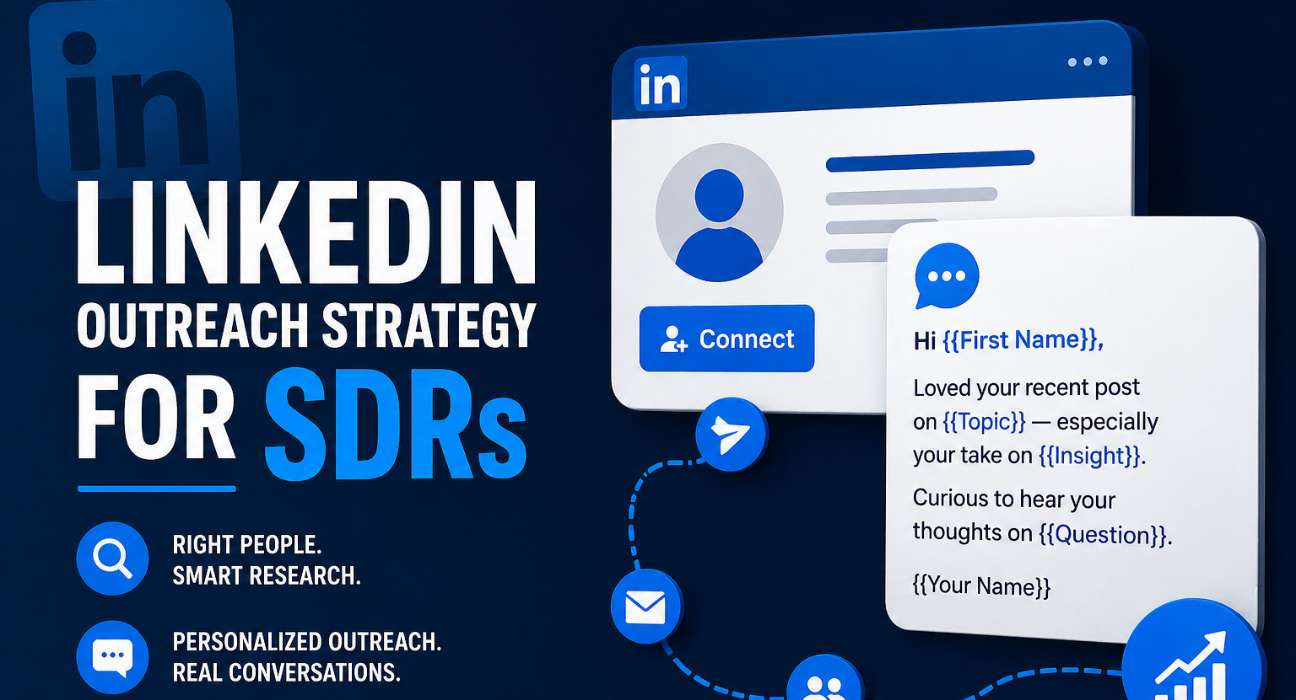
Hi David — saw your team just launched rate intelligence across your Southeast Asia portfolio. Impressive scale. We’ve been working with a few groups in the region on real-time parity monitoring and the patterns are fascinating. Would love to swap notes over a quick call if you’re open to it.
Hey Priya — noticed you mentioned evaluating distribution tech on the Phocuswright panel last month. Curious whether channel mix optimization is part of that review? We’ve got some benchmark data from 500+ hotels that might be useful. Happy to share — no strings attached.
Notice what’s missing from both messages: no company description, no feature dump, no “I”-focused language, no ask for a 30-minute demo. They read like a peer reaching out, not a salesperson pitching.
The Multi-Channel SDR Cadence: LinkedIn + Email + Phone
LinkedIn alone isn’t enough. The data is clear: multi-channel outreach combining LinkedIn, email, and phone boosts engagement by 287% and conversion rates by 300% compared to single-channel approaches.
Here’s how we layer the channels together:
| Day | Channel | Action | Goal |
| 1 | Profile view + comment on their content | Awareness | |
| 2 | Personalized cold email referencing a business signal | First touch | |
| 4 | Connection request with personal note (no pitch) | Warm up | |
| 6 | Follow-up email with value add (report, insight, case study) | Credibility | |
| 8 | Insight message referencing their specific business context | Relevance | |
| 10 | Phone | Brief call referencing LinkedIn connection and email. Direct ask for meeting. | Conversion |
| 13 | Final value message or breakup message | Last chance | |
| 15 | Breakup email. Add to long-term nurture. | Close loop |
The key insight is that each channel reinforces the others. By the time your SDR calls on Day 10, the prospect has already seen their name in a LinkedIn notification, read a relevant email, and possibly engaged with a comment. They know who you are. The call isn’t cold anymore.
What We Measure (And What We Stopped Measuring)
Most SDR teams track activity metrics: messages sent, calls made, emails delivered. We used to do the same. Then we realized we were optimizing for effort instead of outcomes.
Here’s what we track now:
Metrics That Actually Matter
| Metric | Our Benchmark | Industry Avg. | Why It Matters |
| Connection acceptance rate | 38% | 22% | Measures targeting + approach quality |
| LinkedIn reply rate | 18% | 7–10% | Measures message relevance |
| Meetings booked per SDR/week | 3 | 1.5 | Output, not activity |
| Meeting-to-opportunity rate | 45% | 25–30% | Measures qualification quality |
| LinkedIn-sourced pipeline ($) | Tracked monthly | — | Revenue impact |
What we stopped measuring: messages sent per day, connection requests per day, and InMail volume. These vanity metrics incentivize spam. When we removed them from dashboards, message quality went up overnight.
AI in the SDR Workflow: Where It Helps and Where It Hurts
I’d be dishonest if I didn’t address the AI elephant in the room. Yes, 52% of B2B SaaS teams now use some form of AI-assisted outreach. And yes, we use AI tools too. But the way most teams use AI is backwards.
Here’s how we think about it:
AI should handle research, not writing. We use AI to synthesize prospect research — pulling together 10-K filings, recent news, LinkedIn activity, and tech stack data into a brief that an SDR can scan in two minutes. This saves 15–20 minutes per prospect. The SDR then writes the actual message themselves.
AI should suggest timing, not automate sends. We use intent data tools to flag when accounts are actively researching solutions. But we never auto-send LinkedIn messages. Every message goes through a human.
AI should score, not decide. We use AI to score and prioritize accounts based on fit and intent signals. But the SDR makes the final call on whether and how to approach each prospect.
The irony of AI in sales is that the more AI-generated messages flood LinkedIn, the more valuable genuinely human messages become. Use AI to be more human, not less.
Five Mistakes We Made (So You Don’t Have To)
- We treated LinkedIn like an email channel. For the first six months, we just moved our email templates to LinkedIn InMail. Same long pitches, same feature dumps. Response rate: 3%. LinkedIn is a social platform. It rewards social behavior.
- We over-automated too early. We invested in a LinkedIn automation tool before our SDRs understood the fundamentals. Result: three accounts got restricted by LinkedIn within a month. We went back to manual outreach for 90 days to rebuild the muscle, then carefully reintroduced automation only for low-risk activities like profile views.
- We ignored the SDR’s personal brand. A prospect is going to check your SDR’s profile before responding. If it looks like a blank template with a corporate headshot and a generic headline, they’re not responding. We now invest in helping every SDR build a genuine LinkedIn presence: a real headline, a story-driven About section, and at least one post per week.
- We measured the wrong things. When we tracked “messages sent,” SDRs optimized for volume. When we switched to “meetings booked per quality conversation,” everything changed.
- We pitched too early. Our biggest lesson. Every time an SDR pitched in a connection request, the acceptance rate dropped by 60%. The connection request is a handshake, not a sales pitch.
Frequently Asked Questions About SDR LinkedIn Outreach
These are the questions I get most often from other SaaS leaders. I’m including them here because they’re the same questions you probably have.
How many LinkedIn messages should an SDR send per day?
Should SDRs use LinkedIn Sales Navigator?
How long does it take to see results from a new LinkedIn outreach strategy?
What’s the best time to send LinkedIn messages?
Is LinkedIn outreach still effective for enterprise SaaS deals?
How do you handle prospects who accept the connection but never respond?
The Bottom Line
SDR LinkedIn outreach in 2026 isn’t about sending more messages. It’s about sending better ones, at the right time, to the right people, after you’ve earned the right to be in their inbox.
The playbook I’ve shared here isn’t theoretical. It’s what we run at RateGain every day across a global SDR team selling into one of the most competitive SaaS verticals in the world. It works because it respects the prospect’s time, leverages real signals, and treats LinkedIn as what it actually is — a professional community, not a lead gen tool with a messaging feature bolted on.
If you take just three things from this article, make them these: lead with comments, not cold DMs; base every touchpoint on a real business signal, not a static list; and write messages that sound like a real person wrote them, because in a world flooded with AI-generated outreach, being human is your biggest competitive advantage.
Anurag Jain is a digital strategy and AI leader at RateGain Travel Technologies, a global SaaS company serving 13,000+ customers across 100+ countries. He writes about AI, digital marketing, and SaaS growth at digicrusader.com.