Your hotel probably doesn’t have a marketing problem. It has a memory problem, and AI is the first tool that can fix it.
The hotel that never showed up
Every year, my family picks a new destination. This year it was Koh Samui.
In our house, I don’t plan the holiday. My wife does, and she plans it with the precision of an air traffic controller. So one evening she opened an AI assistant and typed what she wanted: the best luxury beach hotel in Koh Samui, for a family of four, with connecting rooms.
The hotel we eventually stayed at didn’t appear in the answer.
She moved to Instagram and scrolled through reels and creator posts. Still nothing. She tried Google’s AI-led results. Nothing again. In the end, she picked up the phone and called the hotel.
That’s when the real problem started. It was a good call. She explained who we were, why we were travelling, and what mattered to us. The person on the line was kind and helpful. And then the call ended, and everything she had said went nowhere. No note. No follow-up. When we arrived, nobody knew we had asked for connecting rooms. When we left, nobody wrote to say thank you.
The property was beautiful. The journey was broken.
There was a real elephant on that trip, by the way. There’s also an elephant in the room for anyone working in hotel marketing today: the guest now owns the relationship, and AI in hotel marketing is changing how that relationship starts, grows and ends.
This guide is for hotel marketers, GMs, revenue managers and owners who want a practical view of what’s changing. It covers:
- how travellers now find hotels through AI, and what to do about it
- why most hotels have a leakage problem, not a demand problem
- what a connected AI-powered guest journey looks like, stage by stage
- how to win more direct bookings and build guest lifetime value
- four free checks you can run on Monday morning
Let’s start with how guests are choosing hotels now.
Why AI in hotel marketing matters right now
For twenty years, hotel marketing followed a simple script. A guest searched, clicked a link, compared a few sites and booked. Our job was to be on page one and look good when they arrived.
That script is being rewritten, and the numbers show how fast.
- 56% of travellers used AI for at least one trip in the past twelve months, up from 33% a year earlier (Phocuswright, US travellers, March 2026).
- 900 million people now use ChatGPT every week (OpenAI, February 2026).
- Traffic from generative AI to travel websites grew 3,500% in a year (Adobe Analytics, July 2024 to July 2025).
- When Google shows an AI summary, clicks to websites fall from 15% to 8% (Pew Research Center, July 2025).
That isn’t a trend line. It’s a ski jump.
Here’s what it means in plain language. The guest is no longer browsing ten blue links. She is asking a question and getting one answer. Your next guest won’t search for you. She’ll ask about you. And the only thing that matters then is what the AI says.
If your hotel isn’t in that answer, you aren’t in the consideration set. A guest who never saw you can’t choose you, however good your rooms are or however much you spend on ads further down the funnel.
Now here’s the uncomfortable part for those of us in marketing. We think we’re ready. Salesforce’s latest State of Marketing research found that 75% of marketers say they’ve adopted AI, yet 84% admit they still run generic campaigns (Salesforce, February 2026).
We bought the Ferrari and we’re driving it in first gear.
The guests, meanwhile, have already moved to AI travel planning. They aren’t waiting for our strategy deck. The gap between how travellers behave and how hotels market is where revenue is quietly leaking out, and that’s the subject of the next section.
You don’t have a demand problem. You have a leakage problem.
When I talk to hotel marketers, the worries are remarkably similar. Are we capturing the full value of demand? Is our spend working harder, or just working? Why did ROAS move, and can anyone explain it?
Underneath all of those questions sits one uncomfortable fact. Hotels don’t lack demand. They lose it.
- 56% of engaged website visitors show real booking intent, yet the average conversion rate is about 2% (GuestCentric via Hospitality Net, 2026). They came to buy, and we made it hard.
- A direct booking is worth about 60% more than an OTA booking, roughly US$519 against US$320 (SiteMinder Hotel Booking Trends, 2025).
- Direct guests come back at about four times the rate: 5.1% against 1.3% for OTA guests (Bookboost via eHotelier, 2026).
- 49% of hoteliers say they can’t access their own critical data, and 40% blame disconnected systems (Revinate and Hapi, 2025).
Read those four lines together and the picture is clear. Guests arrive with intent, our systems can’t hold on to them, the most valuable bookings go elsewhere, and the data that might fix it is trapped in tools that don’t talk to each other.
Here’s the line I’d ask you to remember. Every OTA booking is a guest you rent. Every direct booking is a guest you own.
Renting isn’t always wrong. OTAs bring reach that many hotels can’t buy any other way. But if every guest stays a rental, you pay commission on the first stay, on the second stay, and on every stay after that, because you never built the relationship yourself.
It’s a memory problem
Back to Koh Samui. My wife told that hotel exactly what she wanted. The system forgot it, and every handover started from zero.
Netflix remembers what you watched last night. Your hotel forgot what the guest asked for. That isn’t a people problem, because hotel teams are brilliant. It’s a system that forgets.
So here’s my thesis for this whole article: most hotels don’t have a marketing problem. They have a memory problem. AI in hotel marketing matters because, for the first time, it gives the whole journey a memory.
The guest journey: broken versus connected
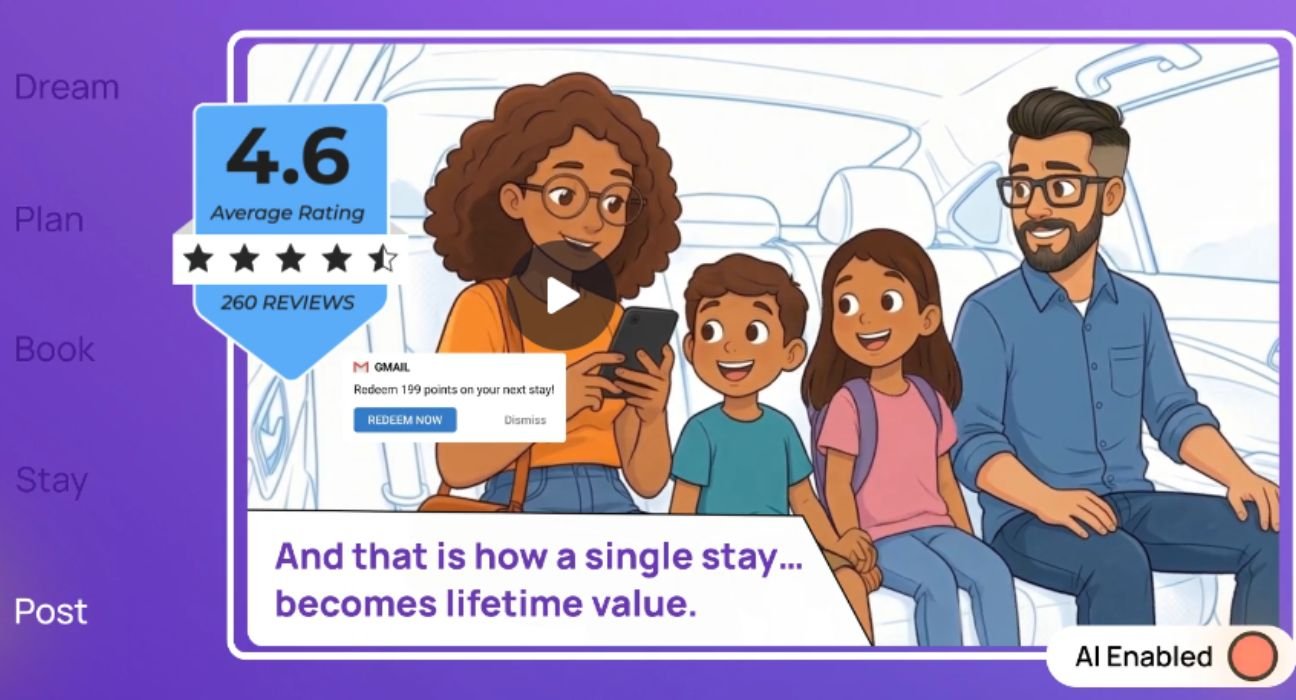
To see where the memory problem bites, walk through the guest journey in five stages: Dream, Plan, Book, Stay, Post.
Think of it as a relay race with five runners and one baton. The baton is everything the guest has told you. In most hotels, every runner drops it.
Here is what my family’s trip looked like, and what the same trip looks like when the journey is connected. Same hotel. Same guest. Only the system changes.
| Stage | Broken journey | Connected journey | What AI does |
| Dream | The hotel is missing from AI answers, Instagram and Google. It’s invisible before the journey starts. | Structured content and aligned signals put the hotel in the answer from the first question. | Reads travel intent and keeps your visibility sharp across AI, search and social. |
| Plan | Four screens, four prices, no consistent story. Confidence drops. | Rates, availability, photos and positioning match everywhere. Each touchpoint builds trust. | Keeps pricing and content in sync across channels. |
| Book | A good phone call, but no data captured and no follow-up. | Why she’s travelling and what she prefers are captured once and carried forward. | Handles chat and voice in the guest’s language and writes to your booking and CRM systems. |
| Stay | Smooth check-in, standard room, no sign the journey before arrival mattered. | She is welcomed by name, with the right offer at the right moment. | Supports staff with an AI concierge across WhatsApp, voice, app and front desk. |
| Post | Silence. The review goes elsewhere. | A personalised thank-you, feedback captured, a reason to return. | Monitors sentiment and triggers the right message to bring her back. |
The left column isn’t a bad hotel. It’s a disconnected one. Every person in that story did their job well. The failure sat between the jobs, in the handovers.
That’s the shift to hold on to. You can’t fix a disconnected journey by adding one more tool at one more stage. You fix it by letting each stage learn from the last. The magic isn’t in any single automation. It’s in the fact that every interaction builds on the one before it.
What AI hotel marketing actually looks like
Most hotels are trying to add AI as a feature. A chatbot here. A caption generator there. That’s fine as a start, but it isn’t where the winners will come from.
The hotels that pull ahead will use AI to augment the whole journey, across demand, distribution, revenue and guest experience. At that point AI stops being a tool. It becomes a multiplier.
Here is what that looks like in practice, one job at a time.
AI for hotel demand generation
Traditional campaigns guess who might travel. AI reads travel intent as it forms: searches, content views, and signals that someone is planning a trip to your destination. Your marketing meets her while she is still choosing, not after she has booked elsewhere.
AI for hotel distribution and pricing
Guests compare you across Google, OTAs and social. If the price, availability and story differ on each screen, trust drops. AI keeps rates, inventory and content aligned across channels and adjusts pricing as demand shifts, so the story holds together wherever she looks.
AI chatbots and voice for hotel bookings
This is where my wife’s phone call would have gone differently. A booking assistant captures why she’s travelling, who with, and what matters, in her own language, and writes it into your systems. The conversation stops being a dead end and becomes the start of a profile.
AI concierge and personalisation during the stay
An omnichannel concierge across WhatsApp, voice, app and front desk can welcome a guest by name, confirm the connecting rooms before she asks, and suggest a spa slot or late checkout at the right moment. It isn’t replacing your team. It’s giving them what they never had: context.
AI for reputation and loyalty
After checkout, AI monitors sentiment, captures feedback and triggers the right follow-up, whether that’s a thank-you, a fix for a complaint or a reason to come back.
Data is the oil. AI is the refinery.
Everyone says data is the new oil. But crude oil doesn’t run your car. You need a refinery. Your hotel already holds the crude: enquiries, reservations, preferences, reviews, loyalty records. AI is the refinery that turns it into a relevant message at the right moment.
The condition is that the pipes connect. One shared guest profile that every system reads and writes is worth more than five clever tools that each keep their own notes.
How to get your hotel recommended by AI search
If the guest now asks and the AI answers, the new job is to be the hotel the AI can confidently recommend. People call this generative engine optimization, or GEO, and it sits alongside traditional SEO rather than replacing it.
Nobody outside the AI companies knows the exact mechanics, and they change often. But one principle holds up well: AI recommends what it can verify, and books what it can reach.
That gives you a practical checklist.
- Answer real questions in plain language. Guests ask things like “best family hotel in Koh Samui with connecting rooms.” Make sure your site says exactly that, on a page that is easy to find. Specifics win: room configurations, distance to the beach, kids’ facilities, accessibility, pet policy.
- Structure your content so machines can read it. Use clear headings, FAQ sections and schema markup for your hotel, rooms, amenities and reviews. If a human skims it easily, a machine usually can too.
- Keep facts identical everywhere. Your name, address, photos, amenities, rates and availability should match across your website, Google Business Profile, OTA listings and social profiles. Contradictions make a recommendation risky for the AI.
- Earn mentions outside your own site. Reviews, press, travel writers and creators all shape what AI systems know about you. Encourage detailed reviews that name what guests loved, such as the connecting rooms or the breakfast.
- Be bookable. A recommendation that ends at a dead page is wasted. Make sure your booking engine works smoothly on mobile and that your inventory is reachable through the connected channels where AI-led booking is emerging.
- Keep it fresh. Update seasonal offers, new rooms and events. Stale pages tell machines, and guests, that nobody is minding the shop.
If you do only one thing this week, take the question your best guest would actually ask and test it. We’ll build that into the Monday audit at the end.
Direct bookings and personalisation: where the money is
Go back to the number that should keep every hotel marketer awake: 56% of engaged visitors show booking intent, and about 2% convert. Closing even a small part of that gap beats almost any new campaign you could launch, because you’ve already paid to bring those people to your door.
This is where AI-driven personalisation earns its place. It isn’t about writing nicer subject lines. It’s about making the website, the offer and the follow-up feel as though they know the guest.
What that looks like on the ground:
- A website that adapts. A family researching connecting rooms sees family rooms, kids’ club details and a package built for them. A couple sees the spa and a quiet-room option. Same site, different front page.
- Offers triggered by intent, not by calendar. If someone has viewed the same suite three times, that’s a signal. A relevant nudge sent at that moment works far better than a bulk email next Thursday.
- One price, everywhere. Direct only wins when the guest trusts it. If the OTA shows a lower rate, she’ll take it, and you’ve lost the relationship as well as the margin.
- A frictionless booking path. Fewer fields, faster mobile, saved preferences, and a way to ask a question without leaving the page.
The evidence for personalising is strong. Bain & Company estimates AI-driven personalisation lifts return on ad spend by 10 to 25%. McKinsey’s research finds that the fastest-growing companies earn about 40% more of their revenue from personalisation than slower ones.
And a loyal guest acquired direct is worth roughly three times one acquired through an OTA, according to Bookboost’s analysis of 2.2 million guests. Last-click reporting will never show you that. Lifetime value will.
The lesson is that personalisation isn’t a campaign. It’s an operating model. It only works when your systems share what they know, which is the memory problem again.
From one booking to a lifetime guest: the maths
Put your marketer’s hat on, because this is where connected AI pays for itself.
Guest lifetime value has only three levers: acquire, engage, expand. Here’s an illustrative example. These figures are a worked scenario, not a client result, so swap in your own.
- She asks an AI assistant for a beach hotel with connecting rooms. You’re in the answer, the price is the same on every screen, and she books direct for A$1,560. Compared with an OTA booking at the same price, you also keep A$281 in commission you didn’t pay.
- The connecting rooms are confirmed before she asks. The concierge greets her by name. She said it once, and every system remembered.
- A spa slot, a birthday cake, late checkout, offered at the right moment and paid in one tap. That adds another A$410.
That single trip is worth A$1,970. Now compare the two paths.
| Path | First stay | What you know afterwards | Likelihood she returns |
| Direct, connected journey | A$1,970 (A$1,560 room + A$410 extras) | Her preferences, her occasion, her contact details | High, because you remember and reach out |
| Through an OTA | A$1,279 net after commission, no extras | Little or nothing | Around 1.3% on average |
If she then returns for roughly three stays of similar value, which is an assumption for illustration, that A$1,970 trip becomes a guest worth about A$5,900. The same guest through an OTA is A$1,279 net, with no data, and a 1.3% chance of ever coming back.
One guest profile, shared by every system. That’s the loop: acquire, engage, expand, and back around again.
This is also why you should change your scorecard. Move from bookings to lifetime value, from volume to quality, from last click to holistic measurement, and from siloed strategies to one connected journey.
Where to start with AI in your hotel marketing
You don’t need five AI systems on day one. You need the baton passed cleanly at one handover, then the next. Here are six principles to keep you honest.
- Start with a business goal, not a tool. “Raise direct conversion by a measurable amount” is a goal. “Buy an AI chatbot” isn’t.
- Fix your data quality. AI amplifies whatever you feed it. Duplicate guest records and messy preferences will give you confident nonsense.
- Protect context and accuracy. Check what the AI says about your hotel. A wrong answer about check-in times or room types costs more than no answer.
- Earn privacy and trust. Tell guests what you collect and why. Personalisation that feels invasive undoes itself.
- Choose partners carefully. Ask how systems connect, who owns the guest data, and what happens when you leave.
- Test and learn. Run one pilot, compare it with a control, then expand.
If you remember only one, remember this: connect the stack, so every interaction builds on the last.
Five moves for hotel marketing leaders
- Personalise with AI. Start where intent is clearest: the booking path and post-stay follow-up.
- Go cross-channel. The guest doesn’t see “email” and “social.” She sees one brand. Make it behave like one.
- Lead on privacy and transparency. Make it a marketing strength, not only a legal checkbox.
- Align your GM, revenue and marketing leaders. If three departments hold three versions of the guest, AI will only make the confusion faster.
- Keep learning. This space changes monthly. Set a regular rhythm to review what’s new.
If your team is small, take comfort. The cheapest fix is almost always consistency: one price, one story, one set of photos. Then connect your booking engine to your CRM so a guest request is captured once. That alone changes the experience.
Your Monday morning audit: four free checks
Here is your homework. Four checks, one morning, zero budget. Do these, and you’ll know exactly where your hotel is forgetting.
- Ask the AI. Open ChatGPT and Gemini and ask each to recommend a hotel like yours, in your city, for your best guest type. Are you in the answer? And could the guest book you from it?
- Check four screens. Look up your hotel on Google, two OTAs and your own site. Is it one price? One story? One set of photos?
- Count the repeats. Between booking and check-in, how many times does a guest have to repeat a request? The only right answer is once.
- Retire a report. Pick one last-click report and replace it with guest lifetime value.
Write down what you find. Most hotels discover the same thing: the problem isn’t effort, it’s handovers.
Back to Koh Samui
Let me finish where I started.
Next time my family goes back, I don’t want a better apology at check-in. I want a hotel that remembers the connecting rooms before she asks.
Because in one version of the journey, you react. In the other, you influence.
The AI-first guest isn’t coming. She’s already here. The way she discovers, decides and experiences hospitality has already changed. So the real question for your next planning meeting is simple: when she plans her next trip, are you shaping that journey, or reacting to it?
AI in hotel marketing isn’t about having more tools. It’s about giving every stage of the guest journey a memory, so that a single stay can become a lifetime of stays.
FAQ: AI in hotel marketing
What is AI in hotel marketing?
AI in hotel marketing means using machine learning and generative AI to attract, convert and retain guests. Common uses include reading travel intent, keeping pricing and content consistent across channels, answering booking questions through chat and voice, personalising offers, and following up after the stay.
How can a hotel get recommended by ChatGPT or Google’s AI answers?
Publish clear, specific answers to real guest questions, use structured data, keep rates and facts identical across every channel, earn detailed reviews and mentions, and make sure your inventory is easy to book. AI tends to recommend what it can verify.
Does AI help increase direct bookings?
Yes, mainly by closing the gap between interest and booking. Many engaged visitors intend to book but don’t. Personalised websites, intent-based offers, consistent pricing and a smoother booking path all help turn intent into direct revenue.
Is AI only for large hotel groups?
No. Independent hotels can start small: fix consistency across channels, connect the booking engine to a CRM, and pilot one use case such as guest messaging or post-stay follow-up.
Will AI replace hotel marketing teams?
It replaces repetitive work like building reports, not judgement, taste or hospitality. Its best use is giving your team a memory, so they can spend their time on the work only people do well.