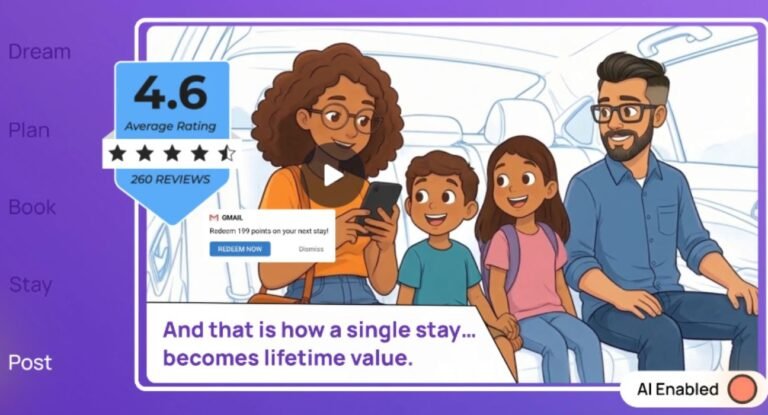
Direct bookings are not won by one tool. They are won by a connected system that brings the right traveller to your site, converts her, and remembers her afterwards.
Why most hotels leak direct bookings
Picture a hotel with a bucket full of demand and holes in the bottom.
The marketing team spends money to pour guests into the top: ads, metasearch, SEO, social. Some of them land on the website. A few of those find the booking engine. And somewhere between the first click and the confirmation email, most of them quietly leave, then book the same room on an OTA for a similar price, a few minutes later.
That’s the leak. And it’s why “get more direct bookings” is rarely a traffic problem alone.
The prize is worth fixing. A direct booking is worth about 60% more than an OTA booking, roughly US$519 against US$320 (SiteMinder Hotel Booking Trends, 2025). Direct guests also come back at around four times the rate of OTA guests (Bookboost via eHotelier, 2026). Yet only about 2% of engaged website visitors convert, even though 56% show real booking intent (GuestCentric via Hospitality Net, 2026).
So the real question isn’t “which channel should we buy?” It’s “what is the whole system that takes a stranger and turns her into a direct guest, then a repeat guest?”
This guide answers that in five layers, from the first impression to the system that remembers her:
- Traffic: how travellers find you, across metasearch, search, PMax, display, social, SEO and AI search.
- Website: what makes a hotel site convert instead of just inform.
- Booking engine: the moment of truth, and which features matter.
- Conversion layer: CRM, omnichannel automation, chatbots, payments and personalisation.
- Foundation: the PMS, channel manager and revenue management system that keep everything honest.
For each layer, I’ll explain what it does, what to ask for, and which vendors operate there, so you can go from strategy to shortlist.
A note on fairness. I work in hotel technology. I lead commercial for Asia Pacific, the Middle East and Africa at RateGain and Sojern, and both are named below. I list vendors alphabetically within each category and describe what each does rather than ranking them. Always check current features and pricing directly with the vendor, because this market changes fast.
The direct booking architecture at a glance
Five layers work as one system, tied together by a single guest profile
Traffic brings guests in. The website and booking engine convert them. The conversion layer remembers and re-engages them. The foundation keeps rates and availability honest. And one guest profile and one rate run through every layer, which is what stops the leak.
Layer 1: Traffic, the channels that bring travellers to you
Traffic has one job: put the right traveller in front of your booking journey at the moment she is ready to decide. The mistake most hotels make is treating every channel the same. They aren’t. Some create demand, some capture it, and some recapture it after a guest leaves without booking.
| Funnel role | Channels | Intent level |
| Create demand | Organic and paid social, display and programmatic, content, creators | Low to medium |
| Capture demand | Metasearch and Google Hotel Ads, brand and non-brand search, Performance Max, local SEO, AI search | High |
| Recapture demand | Retargeting, email and CRM, loyalty, abandoned-booking recovery | Very high |
Here’s how each channel works, what to do first, and who plays in it.
Metasearch and Google Hotel Ads
This is where guests compare your price against Booking.com and Expedia side by side, so it’s the closest thing to a direct fight with the OTAs. Start with free booking links on Google, which show your direct rate at no cost, then add paid Hotel Ads and other metasearch channels like Tripadvisor, Trivago and Kayak. Your booking engine needs to feed rates and availability, and your direct price must be genuinely competitive.
Players: Triptease (metasearch bidding, parity monitoring and retargeting), SiteMinder Demand Plus, Sojern (a broader digital marketing platform that also covers metasearch).
Search: brand and non-brand
OTAs bid on your hotel’s name. If you don’t, a guest searching for you can land on a competitor’s listing. Protect your brand terms first. Then target high-intent, specific searches such as “family hotel with connecting rooms in [destination],” where an independent can beat a marketplace. Keep your Google Business Profile accurate, because for many guests that profile is your first impression.
Performance Max for travel goals
Google’s Performance Max for travel goals lets you run one AI-optimised campaign across Search, YouTube, Maps and Hotel Ads, with direct bookings as the goal (PhocusWire). It’s useful for reach across the funnel, but it doesn’t replace Hotel Ads, which remains the core conversion engine (10 Minutes News for Hoteliers). Treat them as two sides of the same funnel, and make sure your direct rate holds up against what guests see on OTAs.
Display and programmatic
Display reaches travellers while they are still dreaming and planning. The edge goes to platforms that use travel intent data, so you aren’t just chasing anyone who visited a website. Players: Sojern, Adara (a RateGain company), Google Display, Criteo and Triptease for retargeting.
Paid social
Meta and TikTok are strong for inspiration and retargeting. Use your CRM and website audiences, lead with creative that shows the experience rather than the room rate, and judge it on assisted bookings, not only last click.
Organic social and creators
Reels, creator partnerships and guest content answer the question every traveller silently asks: “What is it really like?” Link every post to a page that can actually take a booking.
SEO
You won’t outrank OTAs on “hotels in [city].” You can win on specifics: neighbourhood guides, experiences, packages, family or business-travel angles, and local search. Add structured data, fix page speed, and make every key page answer a real guest question.
AI search
AI assistants are becoming a booking channel in their own right. SiteMinder, for example, has extended its Demand Plus product from metasearch into AI conversational platforms such as ChatGPT and Claude, with reservations processed through its system (Hotel Management). For you, the principle is the same as in my AI-search guide: keep facts consistent everywhere and keep your inventory bookable through connected channels.
Email, CRM and loyalty
The cheapest traffic you will ever get is a past guest who already trusts you. Segment by trip type and send offers that make sense, which brings us to the conversion layer.
Layer 2: The hotel website, where interest becomes intent
Your website has to do two things at once: reassure the guest that this is the right hotel, and make it effortless to book. Most hotel sites do the first and trip over the second.
Think of the website as a shop assistant. A good one greets the guest, answers the obvious questions, and never makes her ask twice. A bad one hides the price and sends her to another shop.
What a converting hotel website does:
- Loads fast on a phone. Most travel research now happens on mobile. A slow page loses guests before they’ve seen a single room.
- Puts the availability search where thumbs can find it. Dates and guests should be visible without scrolling, and the selected dates should carry into the booking engine intact.
- Says why booking direct is better. Spell out the benefits in plain words: best rate, flexible cancellation, a free upgrade or breakfast, early check-in. Direct guests need a reason that an OTA can’t easily copy.
- Shows the price honestly. Add taxes and fees early. Surprise costs at checkout are the quickest way to send a guest back to an OTA.
- Proves it with social proof. Recent reviews, ratings and real guest photos, close to the booking call to action.
- Answers the real questions. Connecting rooms, parking, pet policy, distance to the beach, family facilities. If a guest has to call to find out, many won’t.
- Speaks the guest’s language and currency. Especially important for hotels with international guests.
What quietly kills conversion:
- hidden or late-appearing taxes and fees
- forced account creation before booking
- a booking widget that doesn’t remember the dates
- generic stock photography and brochure-style copy
- no visible way to ask a question
Tools that help on the website layer: website builders and CMS platforms such as SiteMinder’s Website Builder; on-site messaging and parity tools such as Triptease; review and reputation platforms such as TrustYou; and analytics (GA4 plus your booking engine’s own reporting) so you can see where guests drop out.
One practical test. Open your own site on your phone, on mobile data, and try to book a family room for next month. Time it. If it takes more than a couple of minutes, you’ve found your first leak.
Layer 3: The booking engine, your moment of truth
The booking engine is the shopping cart for your hotel. Everything you spent on traffic and website design ends here, and if the experience is clumsy, the guest leaves. For many independent hotels it is the front line of the fight for profitability.
What a good hotel booking engine must do
- Work beautifully on mobile, with a short, clear checkout and few form fields.
- Show live rates and availability that match every other channel, through two-way connections to your PMS, channel manager or central reservation system (CRS).
- Support your guests’ world: multiple currencies and languages, and the local payment methods they actually use.
- Sell more than the room: packages, promo and member codes, add-ons and upsells at the right moment.
- Recover abandoned bookings with timely, relevant follow-up.
- Feed the right channels: connect to Google Hotel Center and other metasearch, so your direct rate appears where guests compare prices.
- Report honestly, with clean tracking so you can see where guests drop out.
The AI features worth asking about
Many vendors now say “AI-powered.” Ask to see exactly what that means in practice.
- Personalised offers and upsells, chosen from what the system knows about the guest and the stay.
- Conversational booking assistants that can answer questions and take a booking inside chat or messaging apps.
- Dynamic content and messaging that changes by guest type, source or intent.
- AI-ready distribution, so your rates and inventory can be found and booked through emerging AI discovery channels.
Who operates here
Vendors are listed alphabetically. Each does something different, so use this as a shortlist, not a ranking.
- Amadeus iHotelier (from the TravelClick business) is a booking engine and central reservation system. Reviewers highlight features like booking-abandonment recapture and loyalty integrations (Hotel Tech Report).
- Cloudbeds combines a PMS, channel manager, booking engine, payments and guest communication in one platform, aimed largely at independent properties.
- Mews is a PMS-led platform that spans POS, revenue management and payments, with booking and distribution connected to the same core.
- RateGain Hotel Booking Engine is RateGain’s direct-booking product, which sits alongside its distribution and marketing offerings.
- SiteMinder Booking Engine is part of a wider platform that includes a channel manager, website builder and the Demand Plus metasearch product.
- SynXis Booking Engine is part of the SynXis central reservation platform, now operated by Aven Hospitality after Sabre sold the business to TPG in 2025 (HSMAI Asia). It’s widely used by hotel groups and chains.
Five questions to ask any vendor
- What conversion rate do hotels like mine see, and how is it measured?
- Which of your AI features are live today, and which are on the roadmap?
- How does the engine connect to my PMS, channel manager, CRM and payment gateway?
- Who owns the guest data, and can I export it if I leave?
- How quickly can I change rates, offers and design myself, without a support ticket?
If you remember one rule: choose the booking engine that fits the rest of your stack, not the one with the longest feature list.
Layer 4: The conversion layer, where memory turns into revenue
This is the layer that fixes the memory problem. It sits around your website and booking engine and does four jobs: remember the guest, talk to her wherever she is, make paying easy, and bring her back.
CRM and the single guest profile
A hotel CRM collects what the guest does and says into one profile: past stays, preferences, spend, source, consent. Without it, every campaign is a guess and every handover starts from zero. With it, you can segment sensibly, for example families who booked in summer, or business travellers who book midweek.
Players: Cendyn (CRM, marketing and revenue tools), Revinate (CRM, email marketing and messaging), and Salesforce for larger groups building their own data layer.
Omnichannel automation
Automation is how you stay in touch at scale without losing the personal touch. The high-value flows are simple:
- Abandoned-booking recovery: a timely message to someone who searched but didn’t book.
- Pre-arrival: confirm preferences, offer upgrades and add-ons before the guest arrives.
- Post-stay: thank-you, feedback request, and a reason to rebook directly.
- Win-back: a relevant offer to guests who haven’t returned in a while.
Run these across email, SMS and WhatsApp, and let each channel read from the same guest profile.
Chatbots and AI booking assistants
A good assistant answers questions at 2 a.m., in the guest’s language, and takes the booking if she’s ready. It also captures what she tells it and writes it into the CRM, so nothing is lost. The best ones hand over smoothly to a human for anything sensitive or complex.
Players: Asksuite (AI reservation assistant), HiJiffy (conversational AI hub with a booking assistant and virtual concierge), Quicktext (the Velma chatbot), Canary Technologies (guest messaging and AI voice), and Triptease (on-site messaging and live chat).
Payment gateway and checkout
Payments are where good intent goes to die. Every extra step, unsupported card or failed transaction costs bookings. Look for a gateway that is secure and compliant, supports the cards and local payment methods your guests use, handles deposits, pre-payment and payment links, and connects cleanly to your booking engine and PMS. Established providers include Adyen, Stripe, Worldpay and Shift4, and many PMS platforms such as Mews and Cloudbeds now offer built-in payments. Check which methods are available in your market before you commit.
Personalisation and loyalty
Personalisation turns data into relevance: the right offer, on the right page, for the right guest. Member rates and a simple loyalty programme give direct guests a reason to book again without going back to an OTA, which matters because direct guests who come back are where lifetime value comes from.
A quick way to judge this layer
Ask one question: when a guest tells us something, how many systems learn it? If the answer is “one,” or worse “nobody,” this is your biggest opportunity.
Layer 5: The foundation, PMS, channel manager and RMS
These systems rarely appear in a marketing plan, yet they decide whether your direct booking engine can be trusted. If the rates are wrong, the availability is stale or the guest data is stuck in a back-office tool, no amount of clever advertising will fix it.
Property management system (PMS)
The PMS is the hotel’s system of record: reservations, rooms, guest folios, check-in and check-out. For direct booking, it matters for two reasons. It holds the truth about availability and guest history, and it needs to pass that data cleanly to your booking engine, CRM and messaging tools. Modern cloud PMS platforms with open APIs make that connection far easier than older, closed systems.
Widely used players: Cloudbeds, Mews, Oracle OPERA Cloud and Apaleo, among many others, with regional and independent-hotel specialists in most markets.
Channel manager and central reservation system (CRS)
The channel manager keeps your rates and inventory in sync across OTAs, metasearch and your own booking engine, so you don’t sell the same room twice or show three different prices. A CRS does a similar job for groups and chains, managing distribution, bookings and rates across many properties from one place.
Why it matters for direct bookings: price consistency builds guest trust, and fast, accurate updates protect your rate integrity across every screen.
Players: SiteMinder, Cloudbeds, and D-EDGE for channel management; SynXis (now operated by Aven Hospitality) and Amadeus iHotelier for chain-scale central reservations; and RateGain, whose distribution technology connects hotels to online travel channels.
AI is arriving here too. SiteMinder, for example, now describes extending its distribution platform to support AI-assisted direct booking and AI-enabled OTA models (Hotel Management).
Revenue management system (RMS)
An RMS recommends the right price for each room, night and channel, using demand forecasts, competitor rates and your own history. Today’s systems increasingly look at total revenue, including ancillary sales, rather than only room rates. For direct booking, the key is that your direct price is a deliberate decision, not an accident. A good RMS helps you hold your best direct rate while staying competitive.
Players: Atomize, BEONx, Cendyn, Duetto, IDeaS and RoomPriceGenie for pricing, plus Lighthouse (formerly OTA Insight) for rate intelligence and market data (Canary Technologies, Hotel Tech Report).
These five layers need to share one source of truth. When the PMS, channel manager, RMS, booking engine and CRM all read the same guest and rate data, the website can be confident, the offers can be relevant, and the hotel stops forgetting.
The direct booking vendor landscape at a glance
Here is the whole stack in one table. Vendors are listed alphabetically within each row, and a vendor may appear in several rows because many platforms span more than one job. This is a shortlist to research, not a ranking.
| Layer | Job | Players to know | Ask before you buy |
| 1. Metasearch and Hotel Ads | Capture high-intent comparison shoppers | Google Hotel Ads, SiteMinder Demand Plus, Sojern, Triptease | How do you bid, and can I control it by date and market? |
| 1. Display and retargeting | Reach and recapture travellers | Adara, Criteo, Sojern, Triptease | How good is your travel-intent data, and how do you attribute bookings? |
| 2. Website | Convert interest into intent | SiteMinder Website Builder, specialist hotel web agencies, Triptease (on-site messaging) | How fast is it on mobile, and can I edit content myself? |
| 3. Booking engine | Take the booking | Amadeus iHotelier, Cloudbeds, Mews, RateGain, SiteMinder, SynXis (Aven Hospitality) | Which AI features are live today, and how does it connect to my PMS or CRS? |
| 4. CRM and email | Remember the guest | Cendyn, Revinate, Salesforce | Can it unify guest data and respect consent? |
| 4. Chat and messaging | Answer, capture and convert | Asksuite, Canary Technologies, HiJiffy, Quicktext, Revinate | Which languages, and how does it hand over to a human? |
| 4. Payments | Make paying easy | Adyen, Shift4, Stripe, Worldpay, PMS-native payments from Cloudbeds and Mews | Which local payment methods and fees apply in my market? |
| 4. Reviews and reputation | Build trust, close the loop | Revinate, TrustYou | Can reviews feed my website and my CRM? |
| 5. PMS | System of record | Apaleo, Cloudbeds, Mews, Oracle OPERA Cloud | Is the API open, and which booking engines integrate? |
| 5. Channel manager and CRS | Keep rates and inventory in sync | Amadeus iHotelier, Cloudbeds, D-EDGE, RateGain, SiteMinder, SynXis (Aven Hospitality) | How fast do updates reach every channel, and does it suit a group? |
| 5. RMS and rate intelligence | Set smart prices | Atomize, BEONx, Cendyn, Duetto, IDeaS, Lighthouse, RoomPriceGenie | How transparent are the recommendations, and how do they connect to my PMS? |
Two market changes worth knowing. The SynXis platform that many people still call “Sabre” is now operated by Aven Hospitality after TPG completed its $1.1 billion purchase of Sabre’s hospitality business in July 2025 (HSMAI Asia). And TravelClick’s iHotelier is now part of Amadeus. Product names and ownership shift quickly in hotel tech, so confirm the current vendor and features before you shortlist.
How to build your direct booking stack
You don’t need every box in the table. You need the right boxes, connected properly. The right shape depends mostly on your size and how much technical capacity you have.
| Hotel type | Sensible starting point | Add next |
| Small independent | An all-in-one platform that combines PMS, channel manager and booking engine, so everything shares one data set | Google free booking links, a chat assistant, simple email automation |
| Mid-size independent or small group | A well-integrated best-of-breed stack with open APIs, so you can swap parts later | Metasearch management, a CRM, retargeting, a revenue management system |
| Large group or chain | A central reservation system plus an enterprise CRM and RMS, with strong governance | Personalisation at scale, loyalty, AI-ready distribution |
These are rules of thumb, not rules. A small hotel with a strong digital team can run a sophisticated stack, and a large one can still be hampered by disconnected systems.
Seven integration checks before you sign anything
- PMS to booking engine. Do rates, availability and reservations sync in real time, both ways?
- Booking engine to Google. Can it feed Hotel Center for free booking links and Hotel Ads?
- Booking engine to CRM. Does every booking, abandoned search and preference land in one guest profile?
- Chat to CRM and PMS. When a guest tells the assistant something, does it reach the people and systems that need it?
- Payment gateway to everything. Does one gateway serve the booking engine, pay-by-link and the front desk?
- Can you follow a guest from first click to booking, across channels, with consent handled correctly?
- Exit plan. Who owns the data, and how easily can you export it?
The common thread is a single guest profile. If you remember nothing else, remember this: buy systems that share what they know. A cheaper tool that traps data costs more in missed bookings than it saves in fees.
How to measure direct booking performance
If you can’t see where guests leave, you can’t fix the leak. Set a baseline for each metric below before you change anything, then review monthly.
| Metric | What it tells you | How to work it out |
| Direct booking share | Whether your overall mix is improving | Direct room revenue divided by total room revenue |
| Booking engine conversion rate | How well you turn visits into bookings | Completed bookings divided by booking engine sessions |
| Funnel drop-off by step | Exactly where guests quit | Share of guests lost between search, room selection, guest details and payment |
| Cost per direct booking, by channel | Which traffic is worth buying | Channel spend divided by direct bookings from that channel |
| Direct versus OTA net revenue per booking | The real value of winning a guest direct | Revenue minus commission and acquisition cost, per booking |
| Abandoned-booking recovery rate | Whether your follow-up works | Recovered bookings divided by abandoned searches contacted |
| Repeat guest rate | Whether guests come back | Returning guests divided by total guests over a period |
| Guest lifetime value | The long-term payoff of each channel | Total revenue per guest over time, by acquisition source |
Two habits make this measurement more honest. First, judge channels on assisted bookings as well as last click, because a social ad that planted the idea deserves credit when a search ad closed the sale. Second, report lifetime value by acquisition source, so you can see that a guest won direct is worth more than the first booking suggests.
Your 90-day direct booking roadmap
Don’t try to fix everything at once. Work from the cheapest, fastest wins to the bigger projects, and move on only when each phase has delivered something you can measure.
Days 1 to 30: stop the leaks
- Run the audit: search your hotel on Google, two OTAs and your own site, on a phone. Is it one price, one story, one set of photos?
- Time a mobile booking from start to finish and note every point of friction.
- Turn on Google free booking links and tidy your Google Business Profile.
- Protect your brand terms in paid search.
- Add clear “book direct” benefits near the booking button.
- Set baselines for the metrics in the measurement section.
Gate to move on: one price everywhere, a booking journey that takes minutes on mobile, and baseline numbers in hand.
Days 31 to 60: capture more high-intent demand
- Add or tune metasearch and Hotel Ads, with your direct rate genuinely competitive.
- Launch Performance Max for travel goals if you have the budget and clean conversion tracking.
- Start retargeting website visitors who didn’t book.
- Publish destination and guest-question content for SEO and AI search.
- Set up abandoned-booking recovery.
Gate to move on: cost per direct booking is known by channel, and abandoned-booking recovery is live.
Days 61 to 90: build memory and loyalty
- Connect your booking engine, CRM and messaging so every guest request is captured once.
- Launch pre-arrival, post-stay and win-back automation.
- Add a chat assistant that can answer questions and take bookings.
- Introduce a simple member rate or loyalty perk for direct guests.
- Start reporting lifetime value by acquisition source.
Gate to move on: a single guest profile exists, and repeat direct bookings are being tracked.
Then repeat. The best-performing hotels treat direct booking as a loop, not a project: acquire, convert, remember, bring back.
FAQ: driving direct bookings for hotels
How can a hotel increase direct bookings?
Treat direct booking as a full-funnel system. Bring high-intent travellers in through metasearch, search, Performance Max and AI search, make the website and booking engine fast and trustworthy on mobile, then use a CRM, messaging and payments to convert and bring guests back. Fix price consistency first, because guests who find a lower price elsewhere will leave.
What technology does a hotel need to drive direct bookings?
At minimum: a PMS, a channel manager, a booking engine, a website that converts, and tracking. To grow further, add a CRM, automated messaging, a chat assistant, a payment gateway that suits your guests, and a revenue management system. They need to share data.
What is the best booking engine for a hotel?
There’s no single best one. Shortlist engines that integrate cleanly with your PMS or CRS, convert well on mobile, feed Google, and show you which AI features are live today. Amadeus iHotelier, Cloudbeds, Mews, RateGain, SiteMinder and SynXis are all worth evaluating, depending on your size and setup.
Does Google Performance Max work for hotels?
Performance Max for travel goals can work well for direct bookings, because it runs across Search, YouTube, Maps and Hotel Ads from one campaign. It doesn’t replace Google Hotel Ads, so most hotels benefit from using both, with a competitive direct rate behind them.
How do AI assistants change hotel direct booking?
Guests increasingly ask AI tools where to stay and, in some cases, book through them. Hotels need consistent facts across every channel, strong reviews, and inventory that is bookable through connected distribution. Some platforms are already extending their distribution to AI conversational channels.