
Why professional caregiving is a vital stepping stone for nursing students
While nursing school gives you the knowledge of what you need to do, it doesn’t always provide the confidence of knowing that you can actually do it when someone’s life is on the line. It’s that area – the gap between studying and achieving, producing and performing – that separates so many. That gap between what you’ve studied and what you can actually do when a patient is in front of you is where a lot of nursing students struggle, and where professional caregiving quietly closes the distance.
It’s not a side job, it’s pre-clinical training
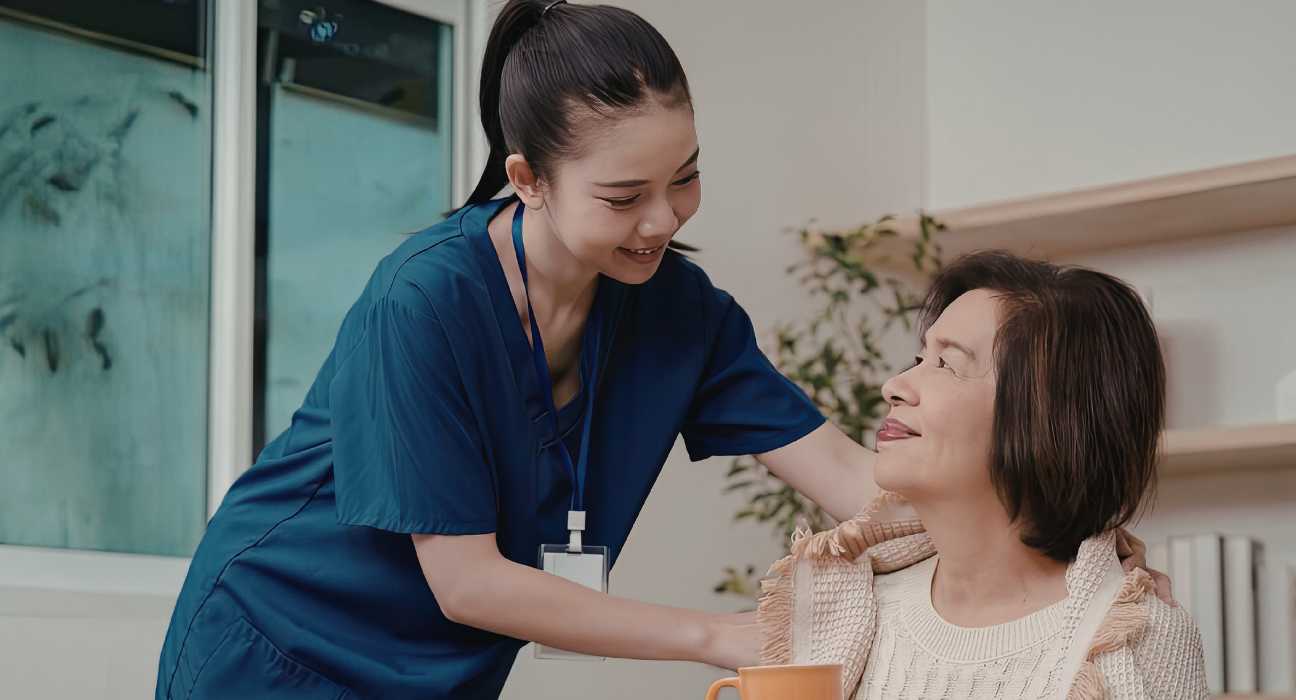
Many nursing students see caregiving as a means to pay the rent through their studies. But it’s about so much more than that. As a caregiver, you will work directly and consistently with patients before you’ve even entered a clinical rotation. You will provide ADLs – bathing, assistance with mobility, feeding, and more – in the real world. With real people. Not two feet from an instructing professor.
Especially in the realm of home health care, your role will be largely that of decision-maker. Is this patient more disorientated than they were yesterday? Does their respiration sound abnormal? You don’t have machines and other medical professionals there in the room to tell you what’s wrong. You must observe and make a decision. You must develop the sort of observational skills that nursing programs spend years developing in students.
The soft skills gap nobody warns you about
Clinical programs can teach you pharmacology, anatomy, procedural technique. They’re less able – for structural reasons, not because they’re bad or you’re bad – to teach you how to calm a frightened 80-year-old at 2 am. Or how you talk to a family member who’s convinced their loved one isn’t being heard. Emotional intelligence, de-escalation, bedside manner: these are not things that you learn through a coursework assignment. They are things you learn through relationships and repetition.
Caregiving builds those every shift. By the time a nursing student with caregiving experience hits their first clinical rotation, they’re not paralyzed by the human side of patient care. They already know how to be present with someone who is scared or in pain. Patient advocacy is another one. Recognizing that a patient’s condition has shifted and knowing how to communicate that to an interdisciplinary team – a nurse, a physician, a social worker – isn’t instinctive. It’s practiced. Caregiving gives you that practice in low-stakes situations before the stakes get higher.
The competitive edge in a crowded field
There is a shortage of nurses, as evidenced by projections from the American Association of Colleges of Nursing that the industry will continue to be understaffed through 2030. That said, it’s not as if prospects for a new graduate are that amazing. You might be a nurse, but hospitals and healthcare systems – those doing the majority of the hiring – still want to see some evidence that you’ve worked with patients, faced the general public as a healthcare worker, and learned what it’s really like to have responsibility when you didn’t have RN and a bunch of numbers behind your name.
A GPA (to look at it simply) tells a hiring manager you studied well. The role of caretaking tells them you showed up, kept someone safe, followed a care plan, documented your observations and your care accurately, and did it over and over regardless of the monotony. Those are two different signals. In a competitive healthcare career market, the second one is often more important than most people realize, and, particularly for many of the better nursing programs themselves, there’s a feedback loop going on where the more experience you come in already having, the more likely you are to be offered admission.
Students in major urban markets will have access to this advantage. The large aging population combined with a robust home care sector means these positions are readily available and often come with the flexibility that someone attending current classes needs. Students looking for caregiver jobs Philadelphia can find roles that build the kind of resume that stands out in nursing school applications and post-graduation interviews alike.
Practical skills that transfer directly to clinical settings
Care plan compliance, HIPAA protocols, basic vital signs monitoring, electronic health record documentation – these aren’t abstract concepts for someone who’s been doing caregiving work for six months. They’re familiar routines. When nursing students encounter these requirements in a clinical context, they’re reinforcing existing knowledge rather than learning from scratch.
Gerontology is worth mentioning specifically. The aging population represents the largest patient demographic in most healthcare systems, and it’s a population that many new nurses feel unprepared to work with confidently. Caregivers who have spent sustained time with elderly patients understand the physical and cognitive patterns of aging in a way that classroom instruction can’t replicate.
There’s also the burnout question. Occupational burnout hits hard in healthcare, often within the first few years of practice. Caregiving teaches boundary-setting and self-care strategies early – not through a workshop, but through experience. Students who’ve already navigated emotionally demanding care relationships tend to enter nursing with more realistic expectations about the work.
What prepared actually looks like
The nursing students who hit the ground running in clinicals aren’t always the ones with the highest grades. They’re usually the ones who’ve already handled a patient’s distress at close range, already asked hard questions at a care handover, already made decisions under uncertainty without a textbook to consult.
Caregiving builds that version of prepared. If you’re in nursing school and weighing how to spend the hours outside of class, that’s worth factoring in.