I sat across from a General Manager in Dubai last quarter. 340 rooms. Twelve-person revenue team. And he asked me the question I hear every single week now:
“Which AI tools should I actually be using?”
Not “should I use AI” — that ship sailed two years ago. The question has moved from if to which.
And honestly? Most of the answers out there are garbage. Listicles written by people who’ve never stepped inside a hotel’s revenue meeting. Tools recommended by bloggers who’ve never had to reconcile a channel manager at 2 AM.
I lead marketing at RateGain — an AI-first SaaS platform that powers 3,200+ hotels, OTAs, and airlines across 100+ countries. Before that, I launched consumer brands from scratch in FMEA markets. I’ve been on both sides: the one building AI tools for hospitality, and the one buying them.
This isn’t a list pulled from press releases. This is what actually works, organized by every layer of your hotel tech stack — from the moment a traveler starts dreaming about a trip to the post-checkout review they leave on Google.
Let’s get into it.
Why 2026 Is the Tipping Point for AI in Hotels
82% of hospitality professionals plan to expand AI usage in 2026 — up from 63% just two years ago. Guest messaging AI has hit 92% adoption among surveyed hotels. BCG published a report calling this the era of “AI-First Hotels” — faster to build, leaner to operate, richer in guest experience.
But here’s what nobody says out loud: most hotels are using AI wrong. They’re bolting a chatbot onto a broken tech stack and calling it transformation.
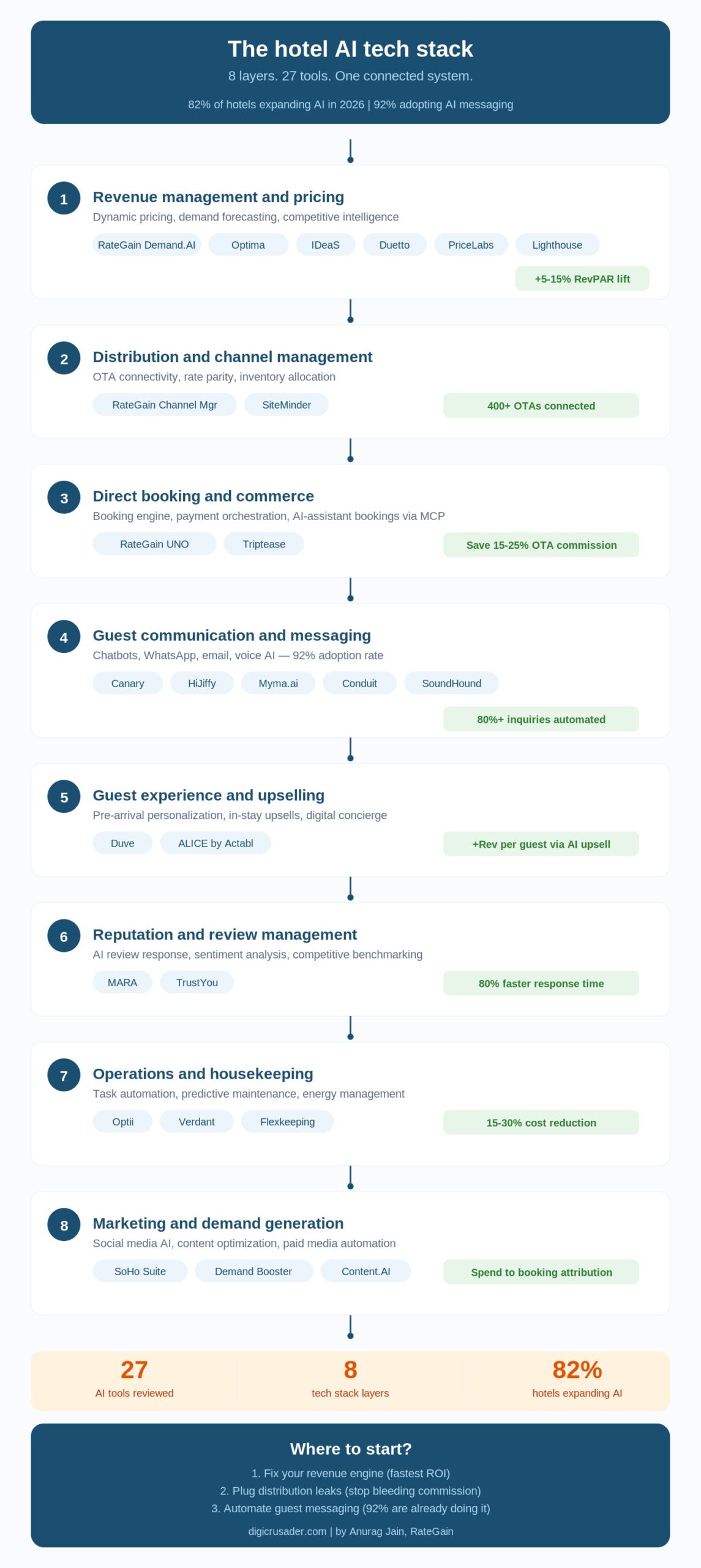
Real AI transformation happens when you think in layers. Your hotel tech stack isn’t one thing — it’s at least eight interconnected systems. And AI needs to work across all of them.
The Hotel Tech Stack: 8 Layers Where AI Matters
| # | Layer | What It Covers |
| 1 | Revenue Management & Pricing | Dynamic pricing, demand forecasting, competitive intelligence |
| 2 | Distribution & Channel Management | OTA connectivity, rate parity, inventory allocation |
| 3 | Direct Booking & Commerce | Booking engine, payment orchestration, conversion optimization |
| 4 | Guest Communication & Messaging | Chatbots, WhatsApp, email, voice AI |
| 5 | Guest Experience & Upselling | Pre-arrival personalization, in-stay upsells, digital concierge |
| 6 | Reputation & Review Management | Review response, sentiment analysis, competitive benchmarking |
| 7 | Operations & Housekeeping | Task automation, predictive maintenance, energy management |
| 8 | Marketing & Demand Generation | Social media AI, content creation, paid media optimization |
1. AI Tools for Hotel Revenue Management & Pricing
This is where AI has the most mature and measurable impact. If you’re not using AI for pricing in 2026, you’re literally leaving money on every room, every night.
RateGain Demand.AI
What it does: Tracks hyper-local demand signals across a city — not just your comp set, but the entire market. Gives you a 75-day forward-looking demand forecast by combining billions of data points from flights, events, search trends, and booking pace.
Why it matters: Most revenue managers react to what happened. Demand.AI tells you what’s about to happen. I’ve seen hotels catch demand surges from events that weren’t even on their radar — a regional cricket match, a surprise concert announcement, a government summit.
Best for: Hotels that want to move from reactive to predictive revenue management.
RateGain Optima (Navigator)
What it does: Real-time rate intelligence that goes beyond traditional rate shopping. Combines competitor rate tracking, rate parity monitoring, and demand forecasting into one dashboard. Tracks CUG promotions and minimum length-of-stay restrictions.
Why it matters: Rate shopping is table stakes. Rate intelligence — understanding why your competitor dropped their rate, whether it’s a parity violation or a genuine strategy shift — is what separates good revenue teams from great ones.
Best for: Revenue managers who need a single source of truth for pricing decisions.
IDeaS Revenue Solutions
What it does: One of the legacy leaders in revenue management systems (RMS). Uses machine learning to automate pricing decisions, forecast demand by segment, and optimize inventory across room types and channels.
Why it matters: If you’re a large full-service hotel or resort running complex inventory with multiple room categories, group blocks, and function space — IDeaS is battle-tested. It’s not the most innovative anymore, but it’s deeply reliable.
Best for: Full-service hotels and resorts with complex inventory and segmentation needs.
Duetto
What it does: Open pricing platform that lets hotels set independent prices for every segment, room type, and channel. AI analyzes pace, pickup, and competitive data to recommend rates.
Why it matters: The “open pricing” philosophy is genuinely different. Instead of cascading discounts from a single rack rate, every price point is independently optimized.
Best for: Hotels transitioning from fixed BAR pricing to a dynamic, segment-driven approach.
PriceLabs
What it does: AI-driven dynamic pricing engine. Hyper Local Pulse algorithm adjusts prices daily based on local supply-demand signals, competitor pricing, events, and seasonality.
Why it matters: If you’re an independent hotel without a dedicated revenue manager, PriceLabs is the closest thing to putting pricing on autopilot. Setup is fast, ROI usually visible within weeks.
Best for: Independent hotels, boutique properties, and apart-hotels without a full-time revenue manager.
Lighthouse (formerly OTA Insight)
What it does: Market intelligence, rate shopping, and “Smart Distribution” — an AI feature that auto-optimizes pricing and channel allocation. Data covers OTA rates, flight searches, and market demand.
Why it matters: Lighthouse has quietly become one of the most data-rich platforms in the space. Smart Distribution is making waves with hotels that don’t have resources to manually manage 15+ OTA connections.
Best for: Independent hotels and small chains wanting enterprise-grade intelligence without enterprise complexity.
2. AI Tools for Hotel Distribution & Channel Management
The distribution layer is where hotels bleed the most money — and where AI can stop the bleeding.
RateGain Channel Manager
What it does: Connects hotels to 400+ OTAs, wholesalers, and GDS with real-time rate and inventory updates. The AI identifies distribution inefficiencies and recommends channel reallocation.
Why it matters: A channel manager that just pushes rates is a commodity. One that tells you which channels are actually profitable after commission, acquisition cost, and cancellation rates? That’s intelligence.
Best for: Hotels connected to multiple OTAs wanting to move beyond “spray and pray” distribution.
SiteMinder
What it does: Cloud-based channel management with connections to 450+ booking channels. Includes booking engine, GDS connectivity, and real-time analytics.
Why it matters: Massive scale and strong reputation among independent hotels. Their “Smart Platform” approach reduces the number of vendors a hotel needs.
Best for: Independent hotels looking for an all-in-one distribution and direct booking solution.
3. AI Tools for Direct Booking & Commerce
Every hotel’s dream: more direct bookings, less OTA commission. AI is finally making this realistic.
RateGain UNO Booking Engine
What it does: Direct-commerce platform combining high-conversion booking engine with rate parity automation, payment orchestration, marketing attribution, and AI-assistant booking via Model Context Protocol (MCP).
Why it matters: UNO is the first booking engine that enables direct bookings inside AI assistants like ChatGPT and Claude. When a traveler asks an AI assistant “find me a hotel in Bali,” UNO serves your property directly — no OTA middleman. 23 languages supported including native RTL Arabic.
Best for: Hotels serious about future-proofing their direct channel against AI-powered search.
Triptease
What it does: Direct booking platform using AI to personalize website experience, show price comparison widgets, and retarget abandoners. “Parity” product identifies where your direct price is being undercut.
Why it matters: Operates at the intersection of conversion optimization and rate parity. If your website conversion rate is below 3%, this tool pays for itself quickly.
Best for: Hotels with existing website traffic wanting to convert more lookers into bookers.
4. AI Tools for Guest Communication & Messaging
The fastest-growing AI category in hospitality. 92% of hotels are either using or implementing AI messaging in 2026.
Canary Technologies
What it does: Full guest journey platform — contactless check-in, AI-powered guest messaging, digital tipping, and upselling. AI handles 80%+ of routine inquiries automatically.
Why it matters: Trusted by 20,000+ hotels including Marriott, Four Seasons, Wyndham, and IHG. Contactless check-in alone saves 5-8 minutes per guest.
Best for: Large hotel groups and branded properties looking for a proven, scalable guest tech platform.
HiJiffy
What it does: AI-powered guest communication hub on proprietary “Aplysia” AI engine. Covers pre-booking FAQs, booking assistance, in-stay requests, and post-checkout review collection across web chat, WhatsApp, Facebook, Instagram.
Why it matters: Strength is multilingual automation. If you’re a European hotel dealing with 10+ languages, this handles it natively. Chat-to-booking conversion rates are consistently strong.
Best for: Hotels with a multilingual guest base and high inquiry volumes.
Myma.ai
What it does: GPT-4o-powered platform for guest messaging across WhatsApp, web, email, and OTAs. Integrates natively with major PMS systems. Includes digital compendium and direct booking conversion.
Why it matters: ROI model: eliminate 15-25% OTA commission on converted bookings, reclaim 60-70% of front desk staff hours, generate passive revenue through AI-triggered upselling.
Best for: Independent and boutique hotels wanting modern AI-native guest communication.
Conduit AI
What it does: Unified chat and voice AI platform. Unlike most chatbots, Conduit unifies the experience — whether a guest calls or sends a WhatsApp message.
Why it matters: Voice is still how most guests communicate with a hotel. Conduit handles both channels with one AI brain. This omnichannel approach is where the industry is heading.
Best for: Hotels with high call volumes wanting to unify text and voice communication.
SoundHound AI
What it does: Conversational AI platform for voice interactions — smart room assistants, lobby kiosks, phone-based concierge services.
Why it matters: If your vision includes voice-activated room controls, in-room ordering, or a virtual concierge guests can talk to naturally, SoundHound is the engine behind it.
Best for: Luxury and tech-forward hotels building voice-first in-room experiences.
5. AI Tools for Guest Experience & Upselling
The money isn’t just in the room rate. It’s in the spa booking, the late checkout, the airport transfer, and the room upgrade.
Duve
What it does: AI-driven guest experience platform automating pre-arrival communication, check-in, upselling, and in-stay engagement. Creates personalized guest journeys — the right offer, to the right guest, at the right time.
Why it matters: A business traveler checking in for one night sees “early check-in + express laundry.” A couple on a weekend getaway sees “spa package + late checkout.” The personalization drives conversion rates manual upselling cannot match.
Best for: Hotels focused on increasing revenue per guest through intelligent, automated upselling.
ALICE by Actabl
What it does: Operations platform with digital itineraries replacing paper-based workflows. Covers concierge requests, housekeeping, maintenance, and guest communications.
Why it matters: Bridges the gap between guest experience and operations. When a guest requests extra towels, AI routes it to the nearest housekeeper, tracks completion, and triggers follow-up satisfaction check.
Best for: Full-service hotels with complex operations and a focus on service excellence.
6. AI Tools for Hotel Reputation & Review Management
Your online reputation directly impacts your ADR. A one-point increase in review scores can increase pricing power by 5-9%.
MARA Solutions
What it does: AI-powered review response platform generating personalized, brand-voice-consistent responses across Google, Booking.com, TripAdvisor. Includes sentiment analysis and competitive benchmarking.
Why it matters: A 200-room hotel generates hundreds of reviews monthly. MARA cuts response time by 80% while maintaining quality. Sentiment analysis surfaces operational issues — if “slow check-in” appears in 15% of reviews, you know what to fix.
Best for: Hotels drowning in reviews that need consistent, professional response rates.
TrustYou
What it does: Guest feedback and reputation platform aggregating reviews from 100+ sources with semantic analysis and comp set benchmarking.
Why it matters: Doesn’t just help you respond — helps you understand. AI breaks reviews into categories (cleanliness, location, service, value) and tracks trends over time.
Best for: Hotels wanting to use review data as an operational intelligence tool.
7. AI Tools for Hotel Operations & Housekeeping
Operations is where AI saves the most labor hours and where most hotels haven’t even started.
Optii Solutions
What it does: AI-powered housekeeping optimization using predictive algorithms to optimize cleaning sequences, predict check-outs, and dynamically assign tasks based on real-time data.
Why it matters: Traditional housekeeping assigns floor-by-floor. Optii assigns based on actual guest behavior — predicted check-out times, DND status, priority arrivals. Labor costs drop 15-20%.
Best for: Hotels with 100+ rooms wanting data-driven efficiency in their largest operational department.
Verdant Energy Management
What it does: AI-powered energy management using occupancy data, weather forecasts, and machine learning to auto-adjust HVAC and lighting.
Why it matters: Energy is typically a hotel’s second-largest cost after labor. Verdant reduces consumption by 20-30% without impacting guest comfort.
Best for: Hotels focused on ESG goals and operational cost reduction.
Flexkeeping
What it does: Hotel operations platform digitizing task management across housekeeping, maintenance, and F&B with AI-powered routing.
Why it matters: Most hotels still run on walkie-talkies and paper checklists. Flexkeeping replaces chaos with clean digital workflows. When a guest reports a leaky faucet, AI creates a ticket, assigns it, sets priority, and tracks resolution.
Best for: Hotels transitioning from paper-based operations to digital workflows.
8. AI Tools for Hotel Marketing & Demand Generation
Marketing is where I live, so let me get specific.
RateGain SoHo Suite
What it does: AI-powered social media growth platform for hospitality. Combines Digital Asset Management, social publishing, and community inbox into one platform.
Why it matters: Most hotel marketing teams are small — sometimes one person. SoHo Suite consolidates everything and uses AI to suggest content, optimal posting times, and engagement responses.
Best for: Hotel marketing teams that need to do more with less on social media.
RateGain Demand Booster
What it does: AI-powered hotel advertising platform combining proprietary business intelligence with automated campaign management across metasearch and paid search.
Why it matters: The problem with hotel digital advertising isn’t budget — it’s attribution. Demand Booster ties ad spend directly to booking revenue and shifts budget toward best-performing channels in real time.
Best for: Hotels spending on metasearch and paid advertising wanting better ROI visibility.
Content.AI by RateGain
What it does: Manages, optimizes, and distributes hotel content across OTAs and demand partners. AI ensures content accuracy and conversion optimization.
Why it matters: Content inconsistency is a silent killer. If your Booking.com listing shows 3 photos but Expedia shows 15, you’re losing bookings. Content.AI identifies these gaps at scale.
Best for: Hotels listed on multiple OTAs struggling to maintain consistent content.
How to Choose the Right AI Tools for Your Hotel
Step 1: Fix the revenue engine first. If your pricing is manual or rate shopping outdated, start here. Revenue management AI has the fastest, most measurable ROI. Results in weeks, not months.
Step 2: Plug the distribution leaks. Rate parity violations and underperforming channels are silent profit killers. Get a channel manager with intelligence, not just connectivity.
Step 3: Stop losing direct bookings. If you’re paying 15-25% commission on bookings that could come direct, invest in a modern booking engine. AI-assistant-compatible engines like UNO with MCP are future-proofing your direct channel.
Step 4: Automate guest communication. Highest adoption rate (92%) for a reason — it works. Start with a chatbot for FAQs and booking inquiries, then expand to WhatsApp, voice, and full-journey automation.
Step 5: Turn reviews into revenue. AI review response is low-cost, high-impact. Protects your ADR and surfaces operational issues you didn’t know you had.
Step 6: Optimize operations last. Not because it’s least important — but operational AI works best when revenue and guest-facing layers are already intelligent.
The Mistakes I See Hotels Make with AI
Buying point solutions instead of platforms. You end up with 12 tools that don’t talk to each other. Your chatbot doesn’t know about the guest’s booking, your RMS doesn’t see review scores. Look for platforms that integrate natively.
Chasing “AI” as a feature, not a solution. Every vendor slaps “AI-powered” on their marketing. Ask: What specific decision does this AI make better than a human, and can you prove it with data?
Ignoring the data foundation. AI is only as good as the data it trains on. If your PMS data is messy and rates are updated on spreadsheets — no AI tool will save you. Clean your data first.
Underestimating change management. The best AI tool fails if your revenue manager doesn’t trust it and overrides every recommendation. Invest as much in training as you do in software.
What’s Coming Next: AI Trends for Hotels 2026-2027
AI-assistant bookings will grow 10x. Hotels connected via MCP and similar protocols will get bookings when travelers ask ChatGPT or Claude for hotel recommendations. Everyone else will be invisible.
Predictive personalization will replace reactive service. AI will know a guest prefers a high floor, extra pillows, and a 6 AM wake-up call before they check in.
Autonomous revenue management will become the norm. The RMS won’t just recommend a rate — it’ll set it, adjust it throughout the day, and optimize by channel without human intervention.
Voice AI will replace the front desk phone. 70% of calls are repeat questions (check-in time, parking, Wi-Fi). AI handles those, freeing staff for genuine hospitality.
Sustainability AI will become a differentiator. AI-powered energy management, waste reduction, and carbon tracking will shift from “nice to have” to “booking factor.”
FAQ: AI Tools for Hotels
How much do AI tools for hotels cost?
Can small hotels benefit from AI tools?
How long does it take to implement AI in a hotel?
Will AI replace hotel staff?
What’s the biggest ROI from hotel AI tools?
The Bottom Line
The hotels that win in 2026 aren’t the ones with the biggest buildings or the most rooms. They’re the ones with the smartest tech stack.
AI isn’t a competitive advantage anymore. It’s the baseline. 82% of your competitors are expanding AI usage this year. The question isn’t whether to adopt — it’s how fast you can build an intelligent, connected stack that makes every room, every rate, and every guest interaction smarter than it was yesterday.
I’ve spent years building AI tools for this industry. And I can tell you with certainty: the gap between AI-powered hotels and everyone else is about to become unclosable.
Don’t be on the wrong side of that gap.