The question came to me in the middle of a strategy review.
I was sitting across a table from a brand manager at a company I won’t name — a large FMCG, the kind that has been on Indian shelves since before most of us were born. We were reviewing quarterly LinkedIn performance for their corporate page.
Impressive numbers. 40,000 followers. Decent engagement. A social media manager dedicated full-time to the account.
And then, almost as an afterthought, the brand manager said something that I haven’t been able to shake since.
“The founder of that little startup that just raised Series A? He has more LinkedIn followers than us. And he posts himself. From his phone.”
She said it like it was a curiosity. A funny data point. Something mildly amusing.
I sat there thinking: that’s not a curiosity. That’s a signal. A big one.
Ten Years. Six Brands. One Pattern I Couldn’t Ignore.
Let me give you some context about where I’m coming from.
I’ve spent the better part of a decade in the rooms where big brand decisions get made. Strategy work for Amazon. Brand management for Johnson & Johnson. Campaign development for Neutrogena, Clean & Clear, Stayfree, and Godrej.
These are not small operations. The media budgets alone would fund most early-stage startups for years. The teams are large, specialized, and deeply experienced. The research backing every decision is exhaustive.
And yet, across all of it, the pattern I kept seeing was the same:
The brands that won in the market were not always the ones with the best product. They were the ones with the most consistent, most trusted, most human presence.
Not the biggest budget. Not the most clever campaign. Not the most creative agency.
Presence. Consistency. Trust.
I saw it at Neutrogena when a competitor with a superior formula lost market share because their communication was erratic. I saw it at Godrej when a decade of consistent brand voice paid off in loyalty that no challenger brand could crack despite spending aggressively. I saw it at Amazon, where showing up in every customer touchpoint — relentlessly, predictably, helpfully — built a level of trust that turned a bookstore into the default place people buy everything.
“The brands that dominate don’t have better products. They have better presence. And they understood that ten years before everyone else.”
I learned that lesson working for some of the biggest companies in the world.
What I didn’t expect was that it would eventually lead me to building something for the smallest.
The Founder Who Changed How I Saw Everything
About two years ago, I started having more conversations with startup founders.
Some were people I met through mutual connections. Some were clients who came to me for marketing advice. Some were founders I followed online who reached out after reading something I’d written.
What struck me wasn’t their ambition — I expected that. What struck me was the gap between what they were building and how visible they were while building it.
One conversation in particular sits with me.
A founder — let’s call him R — was building a B2B SaaS product in the logistics space. Smart guy. Deep domain expertise. Had already closed a handful of enterprise pilots. Was about to raise his seed round.
I looked at his LinkedIn before we spoke. Profile last updated two years ago. Headline: “Co-Founder & CTO at [Company Name].” About section: three lines, mostly technical jargon. Last post: a company update from 14 months ago that got four likes.
I asked him: who’s your ideal investor?
He described exactly the kind of person who spends thirty minutes a day on LinkedIn reading founder content.
I asked: does that person know you exist?
Long pause.
“Probably not,” he said. “But I’m not really a social media person.”
I hear this constantly. And I understand it. Founders are building companies, managing teams, closing deals, handling operations, talking to investors. LinkedIn feels like something you do when you have time. And founders never have time.
But here’s the thing I’ve come to believe very strongly:
“LinkedIn is not something you do when you have time. It is the work. Because your reputation compounds while you sleep — or while you ignore it.”
What I Realised Big Brand Marketing Had Taught Me About Founder Visibility
After that conversation with R, I started thinking about the problem differently.
At Johnson & Johnson, we had a concept we called “always-on presence.” The idea was simple: the consumer should encounter your brand regularly, across multiple contexts, until you become the default they reach for without consciously thinking about it.
We executed this with massive budgets across TV, digital, print, outdoor, influencer, and retail. It was sophisticated, expensive, and effective.
But the underlying principle — show up consistently, in the right places, with a coherent message, until you become trusted — that principle doesn’t require a massive budget.
It requires LinkedIn. Used properly. Used consistently. Used with genuine voice rather than corporate polish.
The founders who are building serious companies and serious reputations simultaneously have figured this out. They post regularly — not every day, but consistently. They write about what they’ve genuinely learned, not what sounds impressive. They engage in other people’s conversations, not just their own feed. They let their thinking be visible even when it’s incomplete.
And the results are measurable in ways that matter: investor DMs before a round. Enterprise buyers who come to a demo already convinced. Talent who apply because they’ve been following the founder for months and want to work with this specific person.
This is not magic. This is the same “always-on presence” principle that built Neutrogena’s skincare dominance in India — just executed by a single human being with a phone and a clear point of view.
The Real Reason Founders Don’t Do This
So if the strategy is clear and the results are real, why don’t more founders do it?
I’ve now asked this question, in various forms, to well over 70 founders. The answers cluster into three categories.
The first: they don’t know what to write. They open the compose box, stare at it, decide nothing they have to say is interesting enough, and close it.
The second: they start, don’t like what they’ve written, and delete it. This cycle repeats until LinkedIn becomes something they feel vaguely guilty about and avoid.
The third — and this is the most honest answer, the one founders give you when they’re being real: they don’t have time. And they’re right. A founder running a 20-person startup does not have forty-five minutes three times a week to write thoughtful LinkedIn content. That time has seventeen better uses.
The problem isn’t motivation. The problem isn’t that they don’t understand the value. The problem is that there’s no system.
And I know how to build systems. That’s what I did for a decade at some of the most system-dependent brand operations in the country.
Why I Built LinkedInFame
I didn’t set out to build a LinkedIn management service. I set out to answer a question that was bothering me.
The question was: what would happen if a founder had the same “always-on presence” infrastructure that a major brand has — but built for one person, at a price point that makes sense for a startup, and executed in a way that actually sounds like a human being rather than a corporate communications team?
The answer, it turned out, was: a lot. Founders who show up consistently on LinkedIn with genuine voice and real insight do not struggle for visibility the way invisible founders do. The compounding effect is real and it starts faster than most people expect.
So I built the system.
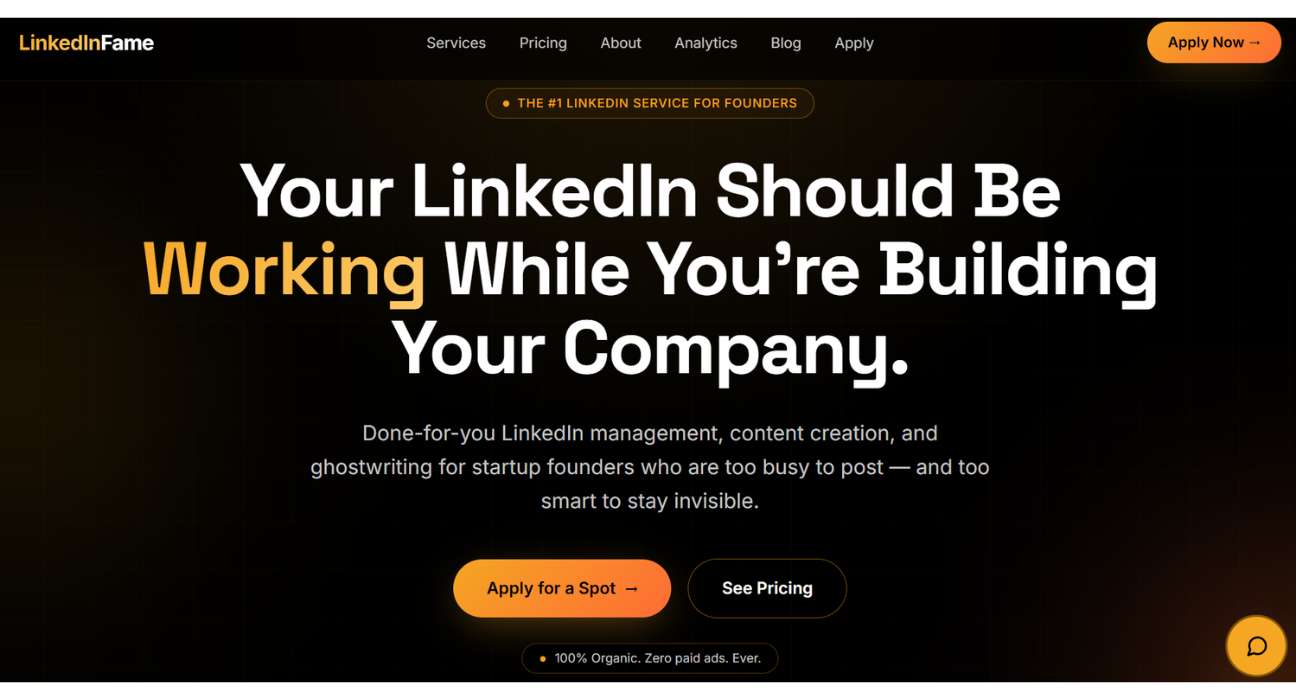
I called it LinkedInFame — a done-for-you LinkedIn service built specifically for startup founders.
The idea was simple: take everything I learned about brand presence, content strategy, voice, and consistency from a decade of working with some of India’s and the world’s most recognized brands — and make it available to the founders who need it most.
No calls. No long onboarding. No agency overhead. A two-minute application form, a 24-hour response, and content that sounds like the founder wrote it on their best day — because the whole process is built around capturing their actual voice, their actual stories, their actual opinions.
Everything is 100% organic. No paid ads, no boosted posts, no sponsored content. Because the entire point is to build the kind of trust that paid reach cannot manufacture.
What Founders Actually Get When They Get LinkedIn Right
I want to be specific, because vague talk about “brand awareness” is not useful to someone trying to raise a round or close an enterprise deal.
Here’s what I’ve seen happen for founders who finally get their LinkedIn working:
Investors reach out. Not because the founder cold-messaged them. Because the investor has been reading their content for eight weeks and decided this is someone worth a conversation. That warm inbound is worth fifty cold emails.
Sales cycles shorten. When a procurement manager at a potential enterprise client has already consumed six weeks of your thinking, they come to the demo pre-sold on your credibility. The trust is built before the call begins.
The best candidates choose you. In a hiring market where great people have options, a founder with a visible and compelling LinkedIn presence is categorically more attractive than one who’s invisible. People want to work with people they can see thinking.
Press comes to you. Journalists looking for founder voices on a topic search LinkedIn. If you’re consistently writing about your space, you show up. I’ve seen founders land media coverage from journalists who found them via LinkedIn content.
Partnerships happen at conferences you didn’t attend. Someone reads your post. Shares it. Someone in that sharer’s network is exactly the strategic partner you’ve been looking for. You get a DM. These things happen more than people expect when the content is good and consistent.
“The ROI on LinkedIn is real. It’s just delayed by about 90 days and invisible to everyone except the founder who’s been showing up.”
The Uncomfortable Question, Revisited
I started with a question that came to me in a strategy review: why does a solo founder with a phone have more LinkedIn authority than a brand with a full team and a real budget?
The answer, I’ve come to believe, is that LinkedIn is the one channel where authenticity is not just a nice-to-have — it is the entire product. And authenticity is the one thing a corporate brand, no matter how well-funded, cannot manufacture at scale.
A founder talking about the hardest month of their startup journey, in their own voice, with the specific details only they could know — that is more compelling than any polished brand campaign. Every time.
The opportunity that most founders are sitting on and not using is extraordinary. Not because LinkedIn is a magic platform. But because showing up consistently, as a real human being with real insight, in a sea of corporate noise, is genuinely rare.
And rare things, in marketing, are always worth paying attention to.
If you’re a founder who knows you should be doing more on LinkedIn but hasn’t found the time, the words, or the system to make it happen —
I built Linkedin Agency for exactly that situation. Take a look.