Salesforce did something last week that sounds like a branding gimmick and isn’t.
It stopped shipping “AI assistants” and started shipping employees. Seven of them, each with a name, a job title, and — this is the part that matters — memory that persists for weeks.
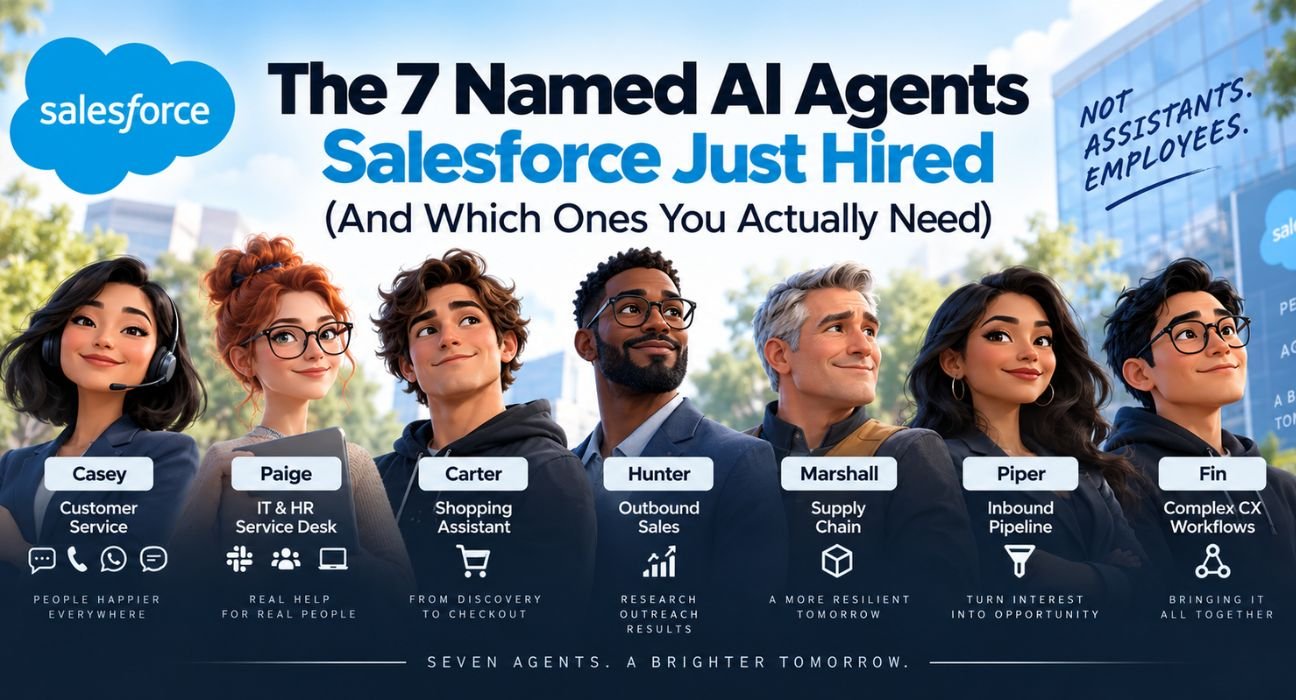
Meet Casey, Paige, Carter, Hunter, Marshall, Piper and Fin.
I’ve spent two decades buying enterprise software, and I want to explain why the naming is the strategy, not the marketing. Then I’ll tell you which of the seven are worth your attention and which are a rename of something you’re already paying for.
The seven, at a glance
| Agent | Job | Where it works | Status |
| Casey | Customer service | Voice, SMS, WhatsApp, web chat | Available now |
| Paige | IT & HR service desk | Slack, portals, employee tools | Available now |
| Carter | Shopping assistant | Commerce — discovery to in-chat checkout | Available now |
| Hunter | Outbound sales | Research through outreach, over weeks | Pilot; GA November 2026 |
| Marshall | Supply chain | Back-office orchestration, audit trails | Available now |
| Piper | Inbound pipeline | Website and inbox lead qualification | Available now |
| Fin | Complex CX workflows | Cross-channel, via Operator and Fin Apex | Available now |
Why giving software a first name changes the sale
Here’s the thing nobody says out loud about enterprise AI: the hardest part was never the technology. It was the budget conversation.
“We need an AI platform licence” is a cost centre. It gets cut. “We’re hiring Hunter to build outbound pipeline” is a headcount decision — and headcount has a different approval path, a different owner, and a number attached to it that a CFO already knows how to evaluate.
Salesforce has moved AI from the IT line to the payroll line. That’s not a naming exercise. That’s a repositioning of where the money comes from.
It also quietly solves the measurement problem. You can’t easily prove the ROI of “an AI platform.” You absolutely can prove it for a named seller: Salesforce says one pilot customer now has Hunter building 60% of their sales pipeline. Whatever you make of that figure, notice how legible it is. That’s the whole point.
Hunter is the one to watch
Six of these seven are strong versions of things that exist. Hunter is different, and the difference has a name: long-horizon runtime.
Nearly every AI agent you’ve used operates in a single session. It answers, it forgets, you start over. Hunter is built to hold a goal across days and weeks — with memory that persists between sessions, durable execution that survives interruption, and the ability to course-correct when circumstances change.
That is the actual frontier. Outbound sales is a brutal test case for it, because outbound isn’t a task, it’s a sequence: research a company, find the right person, reach out, get ignored, wait, follow up differently, notice they changed jobs, adjust. An agent that forgets between sessions cannot do that work. An agent that remembers can.
Hunter is in pilot and goes generally available in November 2026. If you evaluate one thing on this list, evaluate this one — and evaluate it sceptically, because “durable execution over weeks” is the hardest claim in the announcement and the one most likely to be doing more work in the press release than in production.
Piper and Hunter are not the same agent
This is the confusion I’d expect to cost people money, so let’s be precise.
Hunter goes out. Piper takes what comes in.
Hunter does outbound: cold research, cold outreach, building pipeline from nothing. Piper does inbound: someone visits your site, fills a form, replies to an email — Piper engages, qualifies, and converts them before they cool off.
They solve genuinely different problems, and which one you need depends on a question you should be able to answer instantly: is your pipeline problem not enough leads or leads you’re too slow to work? If your form fills sit for six hours before anyone responds, Hunter will make your problem worse by adding volume to a leaky bucket. Fix the leak with Piper first.
Casey, Paige, Carter, Marshall: solid, unglamorous, probably valuable
- Casey handles customer service across voice, SMS, WhatsApp and chat, with pre-built handling for FAQs, returns and account management, plus escalation to a human. If you’re running a support team with high ticket volume and low ticket complexity, this is the clearest ROI on the list.
- Paige is the internal twin of Casey — IT and HR requests, working inside Slack and your employee portals. Every company underestimates how much senior time goes into answering “how do I reset this” and “what’s the leave policy.” Paige is aimed squarely at that.
- Carter is a shopping assistant: product discovery, comparison, questions, and checkout inside the chat. The in-chat checkout is the bit worth testing, because that’s where conversational commerce has repeatedly failed to deliver.
- Marshall orchestrates supply chain back-office work with what Salesforce calls deterministic execution and full audit records. Note that word deterministic — it means the same input produces the same output every time. In procurement and fulfilment, predictability beats cleverness, and it’s a sign Salesforce understands which problems shouldn’t be solved probabilistically.
Fin is the odd one out, and you should know why
Fin didn’t come from Salesforce’s own labs. It arrived through an acquisition completed on 10 September 2026, bringing a customer base reported at over 30,000 companies with it, and runs on its own models — Operator and Fin Apex.
That matters for two reasons. It’s the most battle-tested agent in the portfolio, because it’s been in production at real companies for years. And it’s the one with the most integration risk, because acquired products take time to genuinely merge into a platform. Expect capability overlap with Casey that isn’t fully resolved yet, and ask hard questions about the roadmap before you commit.
The thing Salesforce didn’t announce
Pricing.
Not a number anywhere — not per agent, not per conversation, not per outcome. And for a portfolio pitched explicitly as workforce rather than software, that silence is the most interesting part of the whole launch.
Because if you’re buying an employee, you expect to know the salary. My read is that Salesforce hasn’t settled on the model yet, and is watching pilot behaviour to find out whether the market will accept consumption pricing, per-agent seats, or something closer to outcome-based billing. Whichever way it lands, the first customers in are the ones who set the benchmark — which cuts both ways. You get leverage, and you get repricing risk.
Get your commercial terms in writing, and get a cap.
What to actually do this quarter
Don’t buy seven agents. Nobody needs seven agents.
- Find your single biggest volume-of-repetitive-work problem. Support tickets, inbound leads, internal IT requests. One.
- Match it to one agent — Casey, Piper, or Paige for most businesses.
- Set a baseline before you switch anything on. Current resolution time, current lead response time, current cost per ticket. If you skip this you will never be able to prove the thing worked, and you will end up renewing on faith.
- Run 90 days, then decide. One agent proven beats four agents half-deployed.
- Watch Hunter’s November GA from the sidelines while you do the above.
The companies that will win with this aren’t the ones who deploy the most agents. They’re the ones who pick the right first problem and measure it honestly.
FAQ
How many named agents does Agentforce have?
Which Agentforce agents are available now?
What is the difference between Hunter and Piper?
What does Agentforce cost?
What is long-horizon runtime?
For more such content follow our AI Marketplace.
Salesforce newsroom — salesforce.com/news/stories/agentforce-job-ready-ai-agents/