
AI in Hospitality: What Actually Works for Hotels
Guides, analysis and free tools for hoteliers who want results from AI, not hype. Where it pays off, what it's worth to your property, and how to get started.
By Anurag Jain, bestselling author on AI · Updated
Where AI pays off first in a hotel
Most hotels don't need an "AI strategy" document. They need to know which two or three jobs AI can take off their team's plate this quarter. After years of building and selling hotel technology across Asia-Pacific, the Middle East and Africa, I see the return come from the same five places.
Revenue and pricing
The inputs are already digital: your rates, competitor rates, events and booking pace. AI watches the market hourly and recommends rates your revenue manager accepts or overrides.
First move: run 30 days of AI pricing in shadow mode.
Choosing an AI RMSDistribution and direct bookings
Every booking on your own site keeps more margin. AI keeps rates accurate across channels, flags parity leaks and targets past guests so they book direct.
First move: audit parity and booking-engine conversion.
Direct bookings guideGuest messaging
Most guest questions repeat. An assistant on web and WhatsApp answers them instantly, in any language, and hands anything complex to your team.
First move: write a 50-question guest FAQ.
Guest feedback guideMarketing and reputation
Personalised pre-arrival offers, segment emails, multilingual listings and review replies in your voice, done in minutes instead of days.
First move: AI-drafted review replies, approved by a person.
AI in hotel marketingOperations and AI search
Forecasts that drive staffing rosters, and being visible when guests ask ChatGPT or Gemini where to stay. If AI can't read your hotel, it won't recommend you.
First move: check if AI crawlers can read your site.
Free AI visibility auditFree toolkit for hoteliers
No sign-up neededFind your first AI project
Three questions, and you'll get the three AI projects most likely to pay off for your property, in order.
Compare vendors for each in the best AI tools for hotels.
What could AI be worth to your hotel?
Set the sliders to match your property. The defaults are deliberately conservative, and you can change every assumption.
Change the assumptions
Upsells are valued at 25% of ADR, with an average stay of 2 nights.
An estimate, not a quote. Use it to decide where to look first, then ask vendors to prove their numbers on your own data.
How ready is your hotel for AI?
Eight yes-or-no questions. You'll see your stage and the one next step that matters most.
Answer the questions to see your stage
Your result updates as you go.
Prompts for hotel teams
Paste into ChatGPT, Claude or Gemini and fill in the brackets. Never paste guest names, card details or passport data into a public AI tool.
ReputationReply to a guest review in your voice
You are the guest relations manager at [hotel name], a [type] hotel in [city]. Our voice is [warm, concise, never corporate]. Write a reply to the review below in under 90 words. Thank them for one specific thing they mentioned, take ownership of any issue without excuses, say what we have changed, and invite them back. Do not offer compensation.

Review: [paste review]
DistributionRewrite your OTA and website description
Rewrite our hotel description for [Booking.com / our website]. Audience: [business travellers / families / couples]. Lead with the three things guests praise most in reviews: [list]. Include location facts (distance to [landmarks/airport]), room types, and one reason to book direct. Max 150 words, plain language, no clichés like "nestled" or "oasis".

Current description: [paste]
RevenueSummarise a competitor rate shop
Act as a hotel revenue analyst. Below is a rate shop for my hotel and [number] competitors for the next 30 days. Identify: (1) dates where we are priced more than 10% above or below the comp set median, (2) dates where competitors are sold out or restricted, (3) three pricing actions to consider, with reasoning. Present a short table, then the actions.

Data: [paste table]
RevenueTurn last week's numbers into a GM brief
Here is last week's performance vs budget and last year: occupancy, ADR, RevPAR, pick-up by segment and channel mix. Write a one-page brief for the general manager: what happened, why (likely drivers), what to watch in the next 14 days, and three decisions we need to make. Flag anything unusual.

Data: [paste]
RevenueBuild a demand calendar
List public holidays, school holidays, major conferences, concerts and sports events in [city] and nearby feeder markets [list] for [months]. For each, give the dates, expected impact on hotel demand (high/medium/low) and which guest segment it affects. Mark anything you are not certain about so I can verify it.
Guest experienceCreate a knowledge base for your guest assistant
Using the documents below (house rules, fact sheet, F&B menus, policies), write 50 guest FAQs with short, accurate answers our AI assistant can use. Group them: arrival, rooms, dining, facilities, local area, payments and policies. If information is missing, list it as a question for me instead of guessing.

Documents: [paste]
MarketingWrite a pre-arrival upsell email
Write a pre-arrival email sent 5 days before check-in to a [segment, e.g. couple on a weekend stay]. Offer three upgrades: [room upgrade with price], [experience], [late check-out]. Personal, short, mobile-friendly, one clear button per offer. Give five subject line options under 45 characters.
DistributionDesign a book-direct offer
Our hotel gets [x]% of bookings from OTAs at [y]% commission. Suggest five book-direct perks that cost us less than the commission saved but feel valuable to [target guests], and that respect our parity agreements. For each: cost per booking, how to show it on our website, and how to measure if it works.
OperationsTurn an SOP into a phone checklist
Convert this standard operating procedure into a step-by-step checklist a new [housekeeping / front office] team member can follow on a phone. Use short action verbs, group by stage, add the time each step should take, and highlight safety or brand-standard steps in bold.

SOP: [paste]
HiringWrite a job post and interview guide
Write a job post for a [role] at [hotel], [city]. Include what a great first 90 days looks like, must-have vs nice-to-have skills, and our culture in two lines. Then give eight interview questions with what a strong answer sounds like, including two scenario questions about difficult guests.
10 questions to ask any hotel AI vendor
Tick each one the vendor answers clearly. Fewer than seven? Keep looking.
0 of 10 answered clearly
The hotels getting real returns don't start with a big AI strategy. They pick one or two jobs where the data is already digital and the money is measurable, prove it in 90 days, then expand.Anurag Jain
What's working in hotels, and what's still hype
My rating of twelve common uses of AI in hotels, based on what I see working today.
| Use case | Status | Effort | Payback | My take |
|---|---|---|---|---|
| Dynamic pricing and AI revenue management | Proven | Medium | Months | The highest-return starting point for most hotels. |
| Guest messaging assistant (web, WhatsApp) | Proven | Low | Weeks | Quick to launch if your FAQ content is solid. |
| Review analysis and reply drafting | Proven | Low | Weeks | Cheap, visible, and lifts review scores over time. |
| Content and translation | Proven | Low | Immediate | Use it, but edit in your own voice. |
| Rate shopping and parity monitoring | Proven | Low | Weeks | Stops silent leakage to wholesalers and OTAs. |
| Personalised upsells and pre-arrival offers | Emerging | Medium | Months | Works well once guest data is unified. |
| Demand-based staff scheduling | Emerging | Medium | Months | Strong for larger properties; needs clean forecasts. |
| AI voice agents for reservations calls | Emerging | Medium | Months | Improving fast; test on after-hours calls first. |
| Visibility in AI search and booking agents | Emerging | Low | Ongoing | Low effort, rising stakes. Start now. |
| Fully autonomous revenue management | Hype | High | Unclear | Keep a person in the loop, especially for groups and events. |
| Service robots in lobbies and rooms | Hype | High | Rarely | A good photo, weak economics for most hotels. |
| One platform that "does everything" | Hype | High | Unclear | Tools that integrate well beat all-in-one promises. |
Fix the foundations
- Pick one owner and two goals, such as RevPAR index and direct share
- Check PMS, channel manager and booking-engine connections
- Check rate parity and booking-engine speed on mobile
- Write your guest FAQ and brand voice guide
Run two pilots
- AI pricing in shadow mode, compared daily with your own decisions
- A guest messaging assistant on your website and WhatsApp
- AI-drafted review replies, approved by a person
- Record a baseline for every metric before go-live
Prove it, then scale
- Let pricing auto-publish within guardrails
- Add pre-arrival upsell offers to confirmed bookings
- Compare results with your baseline and comp set
- Keep what paid back and stop what didn't
Reading by topic
All articles →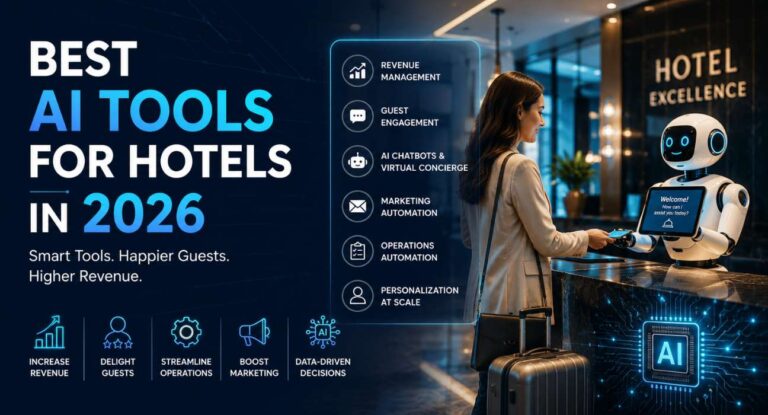
Revenue and pricing
Distribution and direct

Guest experience
Questions hoteliers ask
What is AI in hospitality?
AI in hospitality is software that learns from hotel data such as rates, bookings, guest messages, reviews and demand signals to make or recommend decisions faster than a person can: pricing rooms, answering guests, personalising offers, writing content and forecasting staffing.
How are hotels using AI today?
The most common uses are dynamic pricing and revenue management, guest messaging assistants, review analysis and replies, marketing content and translation, rate and parity monitoring, and demand forecasting for staffing. Pricing and guest messaging usually deliver the clearest returns first.
Will AI replace hotel staff?
No. AI takes over repetitive work such as answering routine questions, monitoring rates and drafting replies, so people can spend more time on guests and decisions. The best results come from tools that recommend and a team that approves or overrides.
What is the best first AI project for a small hotel?
Start where data is already digital and results are easy to measure: AI pricing run in shadow mode, a guest messaging assistant built from a solid FAQ, or AI-drafted review replies. The project finder above ranks them for your property.
How much does AI cost for a hotel?
Costs range from free general AI assistants for content and analysis, to monthly subscriptions for messaging and review tools, to per-room or revenue-share pricing for revenue management systems. Compare the full cost, including setup and integrations, against the expected upside.
How do I measure the ROI of AI?
Record a baseline before launch and track a few numbers weekly: RevPAR index against your comp set for pricing, direct booking share and acquisition cost for distribution, response time for guest messaging, and upsell revenue per stay for marketing.
How do ChatGPT and other AI assistants affect hotel bookings?
Travellers increasingly ask AI assistants where to stay, and AI booking agents are starting to complete bookings. Hotels with clear, consistent, structured information on their website, Google profile and OTAs are more likely to be recommended. Check yours with the free AI visibility audit.
Is guest data safe with AI tools?
It depends on the vendor. Ask where data is stored, who owns it, whether it trains models for other customers, and how the tool complies with GDPR, India's DPDP Act or local rules. Never paste personal guest data into a public AI chatbot.
Glossary
- Dynamic pricing
- Changing room rates often, based on demand, competitor prices, events and booking pace.
- RMS
- Revenue management system: forecasts demand and recommends or sets the best rate for each date.
- RevPAR
- Revenue per available room. Equals ADR multiplied by occupancy.
- ADR
- Average daily rate: room revenue divided by rooms sold.
- OTA
- Online travel agency such as Booking.com, Expedia or Agoda, paid by commission.
- Channel manager
- Pushes rates and availability from your hotel to every sales channel at once.
- Rate parity
- The same room at the same price across channels. A parity leak is when a channel undercuts you.
- PMS
- Property management system: the hotel's core software for reservations, check-in and billing.
- Booking engine
- The reservation tool on your own website that takes commission-free direct bookings.
- Agentic AI
- AI that can take actions such as searching, comparing and booking, not just answer questions.
- Shadow mode
- Running an AI tool alongside your team without letting it act, to compare results safely.
- GEO / AEO
- Generative and answer engine optimisation: making your hotel easy for AI assistants to find, trust and recommend.
Is your hotel visible when guests ask AI where to stay?
The free AI visibility audit gives you a score in under a minute, plus the fixes that matter most.