When Saudi Arabia opened its tourist visa in 2019, hotel leaders across the region kept asking me one question: will the demand really come?
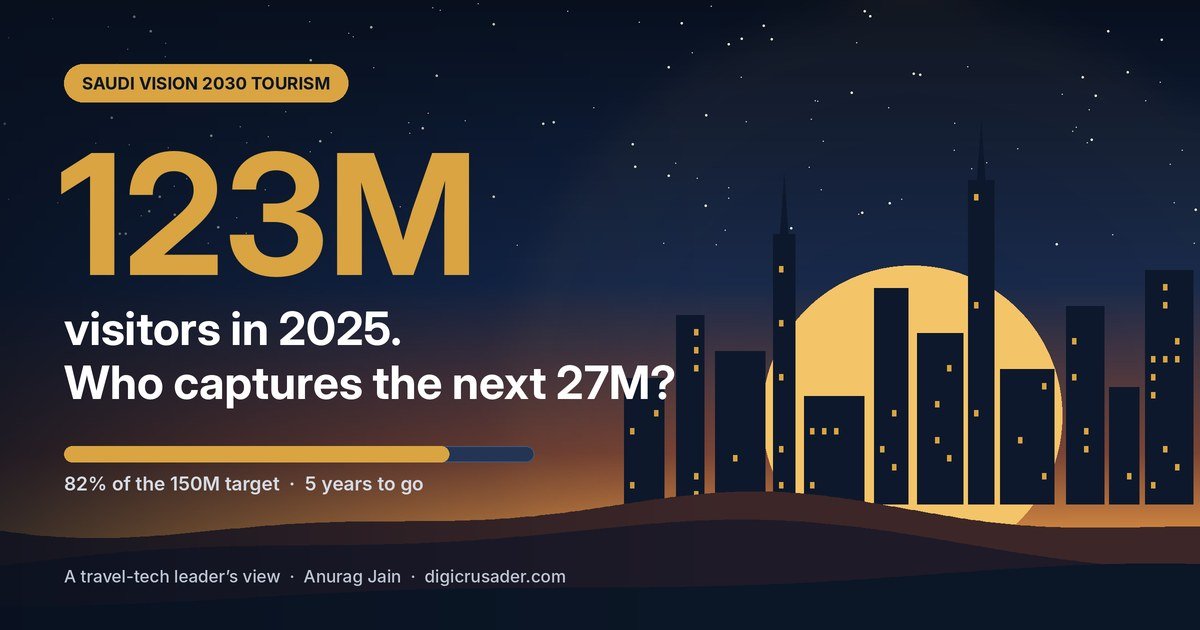
It came. In 2025, Saudi Arabia welcomed about 123 million tourists who spent a record SAR 304 billion (about US$80 billion). Over more than two decades across e-commerce, travel and hospitality technology, at Amazon, Expedia and now RateGain, I have not seen a national tourism build-out move this fast. That is why Saudi Vision 2030 tourism matters to anyone who sells, prices or invests in hotels.
The headline numbers are the easy part. The harder question is who actually captures this demand. As I spend more of my time with hotels across the Kingdom on distribution, pricing and AI, I see one pattern repeating:
The buildings get the press. The technology behind them decides who gets the revenue.
This guide is part of our AI in Hospitality hub, which covers pricing, distribution, guest experience and hotel marketing.
In this article:
- Saudi tourism statistics 2025 and the 150 million target
- What is actually open across the giga-projects in 2026
- Where travel technology will separate winners from the rest
- A practical playbook for hoteliers and investors
- The risks nobody should ignore
- Frequently asked questions
Saudi Tourism Statistics 2025: How Close Is the Vision 2030 Target?
Saudi Arabia is about 82% of the way to its target of 150 million visits a year, with five years to go. The original Vision 2030 goal was 100 million. The Kingdom passed it in 2023, seven years early, and raised the bar to 150 million, including 70 million international visitors.
Here is where things stand, based on the Ministry of Tourism’s 2025 statistical report:
| Metric (2025) | Value | What it means |
|---|---|---|
| Total tourists | ~123 million (+6% vs 2024) | Domestic travel is the engine |
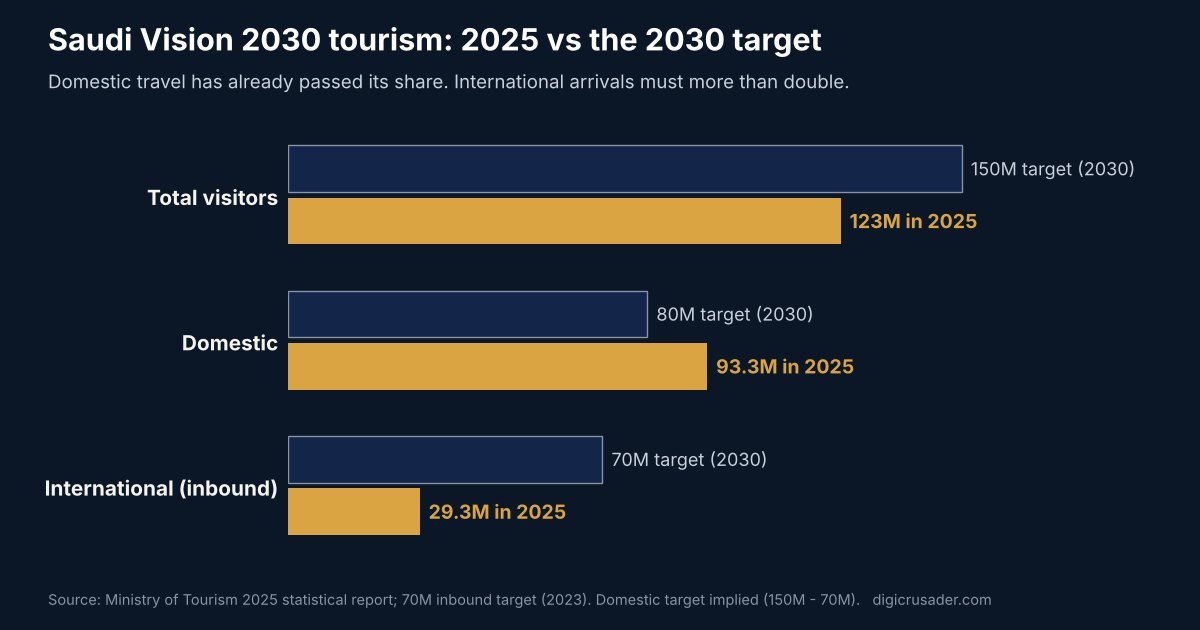
| Domestic tourists | 93.3 million | Saudis are exploring their own country at scale |
| Inbound (international) tourists | 29.3 million | The 70 million goal is the harder climb |
| Total tourism spending | SAR 304 billion (+7%) | Spending is growing faster than volume |
| Inbound spending | SAR 176.6 billion | International visitors spend about 4.4x more per trip |
| Non-religious share of inbound overnight stays | 52% (vs 44% in 2019) | Saudi is no longer only a religious destination |
| Tourism jobs | ~1.03 million | A workforce that needs digital tools to scale |
Two numbers matter most to me as a commercial leader.
First, the inbound gap. If 70 million of the 150 million visits are to be international, the domestic share is about 80 million, and domestic travel has already passed it. International arrivals, though, need to grow from 29 million to 70 million in five years. That gap will be closed by global distribution, not by local demand.
Second, spending per visitor. An inbound traveller spends about SAR 6,000 per trip, against roughly SAR 1,360 for a domestic one. Every hotel that wins a bigger share of international, higher-value demand wins disproportionately.
Saudi Giga-Projects and Tourism: What’s Actually Open in 2026
The giga-projects are real, but they are arriving in phases, and some have been rescoped. That matters for anyone planning around them. Here is my reading of where the main tourism projects stand:
| Project | Status in 2026 | Why it matters for tourism |
|---|---|---|
| Six Flags Qiddiya City | Open since 31 December 2025. Home to Falcons Flight, billed as the world’s tallest, fastest and longest roller coaster (163 m, 250 km/h) | A family and entertainment draw on Riyadh’s doorstep |
| The Red Sea | Red Sea International Airport operating; five of 16 phase-one resorts open, with more on Shura Island opening through 2026 | Luxury, regenerative tourism with long booking windows |
| Diriyah | Bujairi Terrace and Bab Samhan hotel open; close to 40 hotels planned, most expected from 2027 | Heritage tourism minutes from central Riyadh |
| NEOM | Being scaled back. Sindalah island has not opened to the public, and the 2029 Asian Winter Games at Trojena were postponed and moved to Almaty | Fewer, more focused openings than first announced |
| AlUla | Operating heritage destination with resorts and a year-round events calendar | Proof that cultural tourism can command premium rates |
Behind these headline names sits a much larger hotel build-out. Knight Frank estimates Saudi Arabia will add around 320,000 hotel rooms by 2030, with about two-thirds of the new supply in the luxury, upper-upscale and upscale segments.
That creates a problem few people talk about. When thousands of upscale rooms open in the same few years, the challenge moves from building supply to filling it profitably. New hotels have no booking history, no loyal guests and no brand awareness in key source markets. That is a technology problem as much as a marketing one.
Travel Technology in Saudi Arabia: Where the Real Race Is
Saudi Arabia is building its tourism economy in the AI era, and that is its biggest advantage. Older destinations carry legacy systems built over decades. The Kingdom can leapfrog them. From where I sit, four areas will decide who wins.
1. Distribution: be visible where 70 million guests will search
Most international travellers will discover a Saudi hotel through an online travel agency, a metasearch engine, a tour operator in their own country or, increasingly, an AI assistant. If your rates and content are not cleanly connected to those channels, you are invisible to the very demand Vision 2030 wants to attract.
The priority is not more channels. It is the right channels for each source market, with accurate content in the right language and rates that stay in parity.
2. Pricing: revenue management for a market with no history
Traditional revenue management relies on last year’s data. A hotel that opened in 2025 does not have a last year. Events also shift demand overnight, from Riyadh Season to the Formula 1 race in Jeddah to major concerts.
This is where AI-driven pricing earns its keep. It reads competitor rates, flight searches, events and booking pace as they change, so new hotels can price with confidence from day one.
3. Data: know the guest before they arrive
Saudi hotels now serve very different travellers at once: Umrah pilgrims, domestic families, European luxury travellers and business visitors. Treating them as one audience wastes margin. Hotels that bring booking, guest and market data together can personalise offers and stop leaking revenue to discounting.
4. AI agents: the next booking channel
In my book, Powerhouse: An AI Playbook, I argue that AI will change how decisions are made in every industry. In travel, it is happening fast. Travellers are starting to plan trips by asking AI assistants, and those assistants favour hotels whose data is structured, current and trustworthy.
For a destination that wants to more than double international arrivals, being AI-ready is now part of being market-ready. You can check how visible any hotel website is to ChatGPT and Google’s AI answers with our free AI visibility audit.
To go deeper, see my guides to the best AI tools for hotels and how AI is changing hotel marketing.
A Practical Playbook for Hoteliers and Investors in Saudi Arabia
If I were opening or running a hotel in the Kingdom today, these are the six things I would do first.
- Pick your source markets before your channels. The GCC, India, China, the UK and Germany behave very differently. Build your distribution mix around the guests you actually want.
- Get your content right in every language you sell in. Arabic and English are the minimum. Add Mandarin or Hindi when your data shows demand from those markets.
- Price for events, not seasons. Riyadh Season, sport and concerts move demand more than the calendar does. Use pricing tools that react in hours, not weeks.
- Build direct booking from day one. Online travel agencies help a new hotel get discovered. A strong website, loyalty and CRM let you keep the guest the second time. Here is my full-funnel guide to direct bookings.
- Make your data AI-ready. Keep rates, availability, photos and descriptions accurate and structured. That is what AI assistants and metasearch engines read.
- Invest in people and tools together. With over a million tourism jobs and many new hires, technology that removes manual work is how teams deliver luxury service at scale.
For investors, I would add one test to any Saudi hospitality deal: how will an international guest who has never heard of this asset find it? If the answer is unclear, the forecast probably is too.
The Challenges of Saudi Vision 2030 Tourism
Being optimistic does not mean ignoring the risks. These are the ones I watch most closely:
- Supply arriving faster than international demand. If rooms open before air connectivity and awareness catch up, rates will come under pressure, especially in luxury.
- Project rescoping. NEOM’s scale-back and the move of the 2029 Asian Winter Games show that timelines and scope can change. Plans built on one giga-project carry more risk than plans built on the wider market.
- Talent. Luxury service needs skilled people, and the hiring pipeline is still catching up with the room pipeline.
- Perception in source markets. Many travellers still do not know what Saudi Arabia offers beyond religious travel. Closing that gap takes years of consistent marketing.
- Dependence on domestic demand. About three in four tourists today are domestic. Reaching 70 million international visitors needs a step change in global reach.
None of these are reasons to stay out. They are reasons to go in with better data, sharper distribution and realistic forecasts.
Saudi Vision 2030 Tourism: Frequently Asked Questions
What is the Saudi Vision 2030 tourism target?
Saudi Arabia aims for 150 million visits a year by 2030, including 70 million international visitors. The original target was 100 million, which the Kingdom reached in 2023.
How many tourists visited Saudi Arabia in 2025?
About 123 million, according to the Ministry of Tourism: 93.3 million domestic and 29.3 million inbound tourists, who together spent SAR 304 billion.
Is Saudi Arabia on track to hit 150 million visitors?
Overall, yes. It reached about 82% of the target in 2025, and domestic travel has already passed its share. The harder part is international arrivals, which need to grow from 29 million to 70 million by 2030.
What are the main Saudi giga-projects for tourism?
The main ones are the Red Sea, Diriyah, Qiddiya, AlUla and NEOM. Six Flags Qiddiya City opened in December 2025, Red Sea resorts have been welcoming guests since 2023, and Diriyah’s first hotel is open with dozens more planned.
How many hotel rooms is Saudi Arabia building?
Knight Frank estimates around 320,000 new hotel rooms by 2030, with about two-thirds of the new supply in the luxury and upscale segments.
What role does technology play in Saudi tourism?
Technology decides how new hotels are found, priced and booked. Distribution, AI-driven revenue management, unified guest data and AI-ready content will help hotels capture international demand.
Is Saudi Arabia a good market for hotel investment?
The demand story is strong, backed by record visitors, rising spending and government support. The key risks are new supply arriving faster than international demand and project timelines shifting. This is a market view, not investment advice.
The Next Five Years Belong to the Hotels That Get Found
Saudi Vision 2030 tourism has already proved the doubters wrong once, by hitting 100 million visits seven years early. The next milestone, 150 million visits and 70 million international guests, will be won differently. It won’t be won only by who builds the most striking resort. It will be won by who connects that resort to the world most intelligently.
If you are a hotelier, owner or investor in Saudi Arabia thinking about distribution, pricing or AI, I would love to compare notes. Connect with me on LinkedIn, leave a comment below with the biggest challenge you face, or invite me to speak at your next leadership event.
About the author: Anurag Jain (AJ) is EVP, Commercial & Go-to-Market at RateGain and Sojern, leading Asia-Pacific, the Middle East and Africa. He has worked at Amazon and Expedia and is the bestselling author of Powerhouse: An AI Playbook.
Sources
- Arab News: Saudi tourism spending hits record in 2025 (Ministry of Tourism report)
- Gulf News: Saudi Arabia targets 70 million international visitors a year
- Falcons Flight (Six Flags Qiddiya City)
- AGBI: The Red Sea project
- Fact Magazine: All the new hotels in Diriyah
- AGBI: What happened at NEOM’s Sindalah
- Skift: NEOM scale-back and Winter Games delay
- Travel Tomorrow: Almaty replaces NEOM as 2029 Asian Winter Games host
- Gulf News: 320,000 new hotel rooms by 2030 (Knight Frank)