Short on time? Here’s today in three lines:
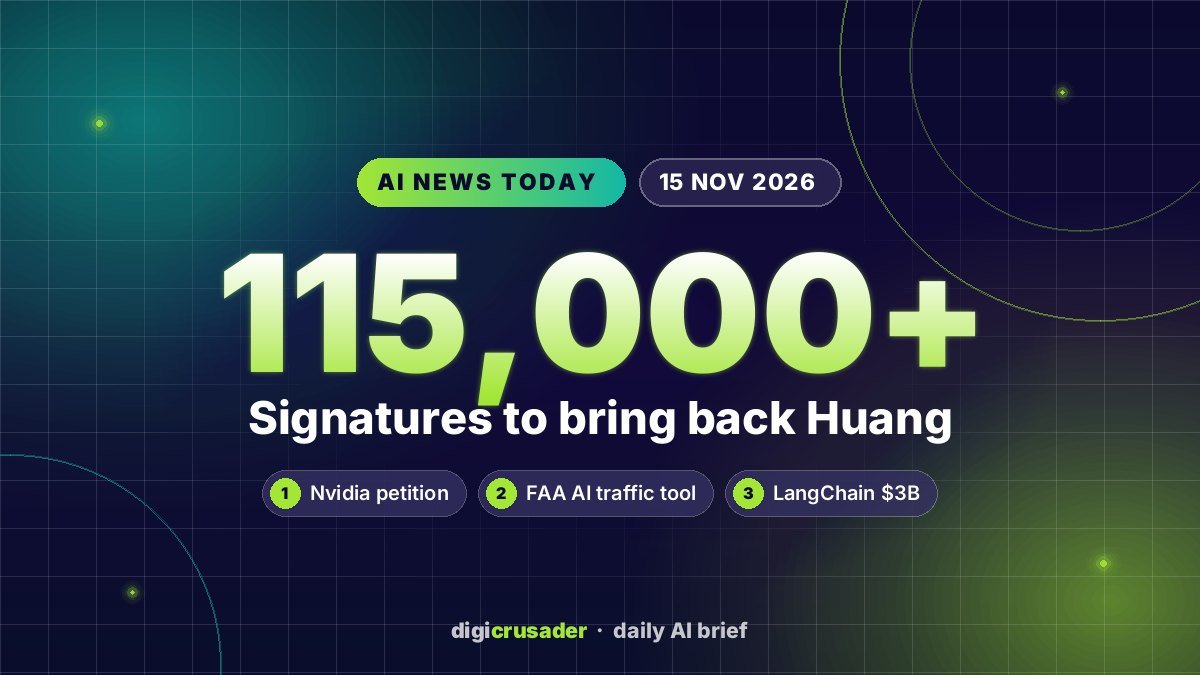
- More than 100,000 people, including Elon Musk, want Nvidia to bring back Jensen Huang. Governments are checking their chip supply.
- The US aviation regulator has expanded an AI traffic planner to every en route control centre in the country.
- LangChain raised $300M at a $3B valuation. Businesses are paying real money to manage AI agents.
1. 100,000+ signatures for Jensen Huang. Nvidia’s crisis is now a supply-chain story.
A petition asking Nvidia’s board to reinstate Jensen Huang passed 115,000 signatures on Saturday, TechCrunch reports. Elon Musk, Replit’s Amjad Masad and Epic Games’ Tim Sweeney back it. The site lists thousands of people who say they are current Nvidia employees, though organisers admit they are still removing fake entries, Yahoo Finance notes. CFO Colette Kress is interim CEO, and the board says it will look at internal and external candidates.
Governments are reacting too. South Korea says Nvidia reaffirmed its plan to supply 260,000 advanced GPUs, and its AI strategy council held an emergency meeting. Taipei’s city government says Nvidia’s planned overseas headquarters there is on track. Japan says it will monitor closely, according to TechCrunch.
Why it matters: Nvidia sells the chips almost every AI service runs on. When its leadership wobbles, countries and cloud providers start asking about delivery dates.
Our take: A petition will not decide who runs Nvidia; the board will. For most businesses, nothing changes this quarter. Your AI tools run on cloud contracts, and those chips are already ordered. But this is a useful moment to ask your main AI vendors one plain question: which model and cloud do you depend on, and what is your backup?
2. AI is now advising US air traffic flow nationwide. Controllers keep the final say.
The FAA has expanded SMART, an AI-supported traffic management system, to all 22 en route traffic control centres, AVweb reports. It was built by Air Space Intelligence under a 12-year contract valued at $875 million. It first went live around the three Washington-area airports on 21 September. The FAA says it has rerouted 180 flights so far, saving an average of 10 minutes and nearly 80 gallons of fuel per flight.
The system suggests schedules and routes; humans decide whether to use them, and controllers stay responsible for keeping aircraft apart. More than two dozen lawmakers had asked the FAA to pause the rollout until it answered questions on safety testing and training. Ars Technica reports that airlines praised the tool, but the controllers’ union wasn’t involved.
Why it matters: This is one of the largest public tests of “AI advises, humans decide” in a safety-critical system.
Our take: The numbers are modest so far, and that is fine. Ten minutes per flight adds up across a national network. The bigger lesson is the design: the AI recommends, a named person approves. Copy that pattern for any AI that touches customers or money. Also note the warning sign: leaving the people who do the job out of the rollout is how good tools get resisted.
3. LangChain hits $3B. The money is moving to managing agents, not just building them.
LangChain raised a $300 million Series C led by CapitalG at a $3 billion valuation, TechCrunch reports. That is more than double its $1.25 billion valuation about a year ago. GIC, DFJ Growth, IVP and Sapphire Ventures also joined.
The company started in 2022 as an open source project. Its main product is now LangSmith, a platform for building and managing AI agents that isn’t tied to one model or cloud. LangChain says it has 7,000 LangSmith customers, including Rippling, Toyota and Salesforce.
Why it matters: Once a company runs more than a handful of agents, it needs to see what they do, test them and control costs. That layer is becoming its own market.
Our take: Model-neutral tooling is smart insurance in a week when even Nvidia’s leadership looks uncertain. If you are building agents, keep your prompts, tests and logs in a layer you control, so you can switch models without starting again.
Quick hits
- Amazon has drafted plans for a “World Product Graph” covering products sold across the web, even ones it doesn’t stock. Amazon says the draft may not reflect current plans.
- Nvidia’s security chief quietly left in August, TechCrunch reports, raising questions about oversight before the Huang crisis.
- TechCrunch’s running AI graveyard lists the projects and startups that shut down or missed expectations. Worth a skim before your next vendor bet.
- Comparing agent and automation tools? Browse 1,000+ AI tools in our free directory.
What this means for travel and hospitality
SMART is the travel story to watch. Fewer and shorter delays mean fewer missed connections, late check-ins and rebooking headaches for hotels near busy hubs. It is early, and the FAA’s figures are its own. But airport hotels and travel managers should track whether on-time performance improves around the Washington airports first.
Amazon’s product graph matters too. AI agents will soon compare rooms the way they compare products, using whatever data they can read. Make sure your own website describes your property clearly. Our AI crawler checker shows which AI bots can reach your pages.
One move for Monday
List every AI tool your team relies on. Next to each, write which model it runs on and what you would do if it went down for a week. If you can’t answer, ask the vendor this week.
Get the week’s most useful AI moves in our free weekly brief, or catch up on all our AI news.